
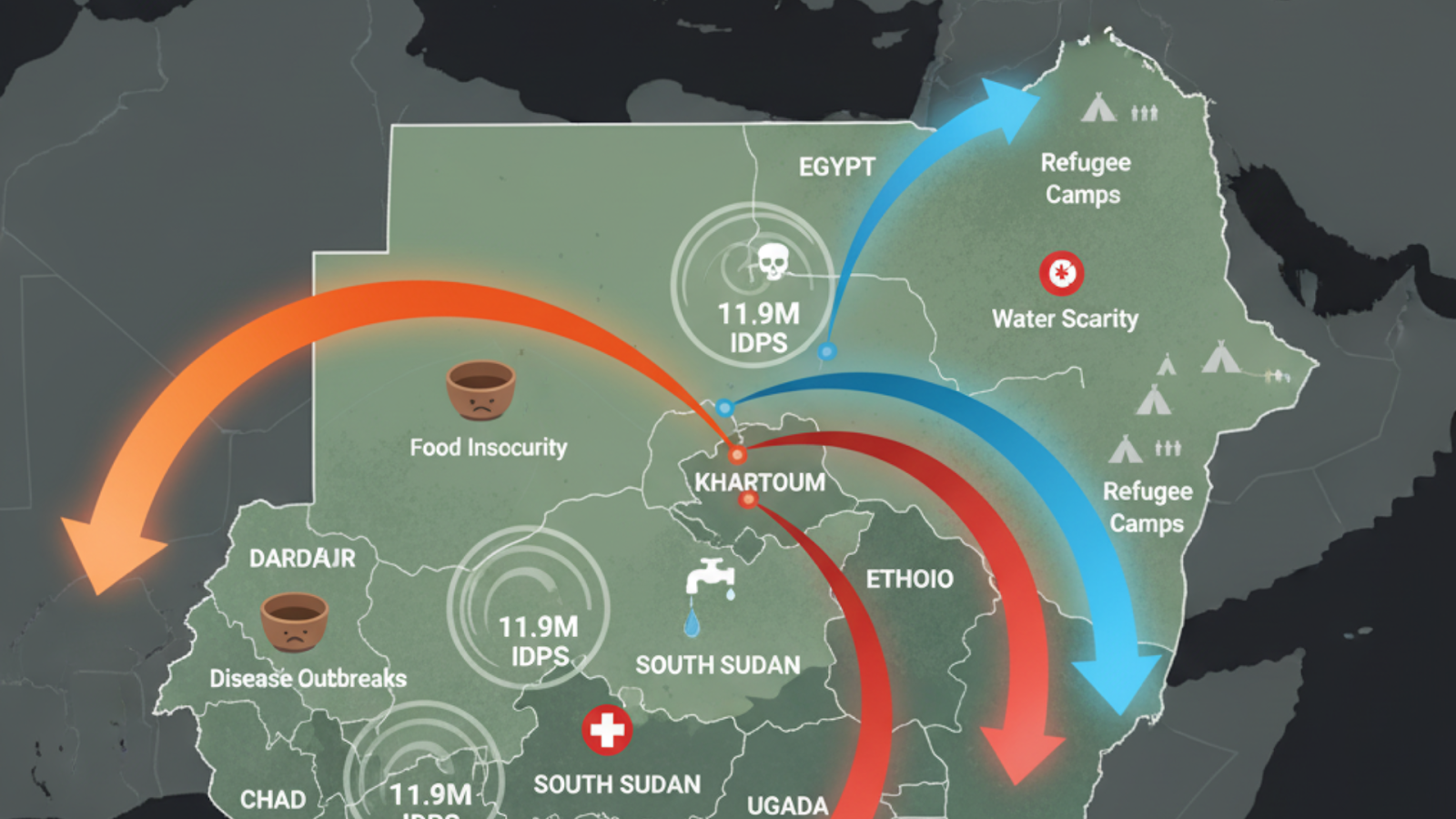
The conflict that erupted in April 2023 has spiraled into a full-blown humanitarian catastrophe, leaving millions displaced and entire communities stripped of basic survival. Sudan’s humanitarian crisis now stands among the largest in world history, with more than 11.9 million forcibly displaced as of mid-2025. According to UNHCR’s operational portal, this includes over 4.1 million newly arrived refugees and asylum-seekers in surrounding countries. Such staggering numbers make Sudan’s refugee crisis not just a national tragedy, but a test of global resolve.
Half of Sudan’s population—over 30 million people—now require urgent humanitarian support. Famine has already been confirmed in some camps in Darfur, health systems are collapsing, and the rainy season threatens further access breakdowns.Immediate global attention is critical—not only to save lives, but also to uphold dignity, protection, and hopes for recovery.
What is the scale of displacement in Sudan?
Internal displacement (IDPs) and trends
Sudan currently hosts the world’s largest internal displacement crisis. UNHCR and its data portal record nearly 11.9 million people forcibly displaced from their homes within Sudan. Many have been displaced repeatedly, moving between states as frontlines shift. Global Trends reports that Sudan’s internal displacement grew by 2.5 million in 2024 alone, reaching about 11.6 million.
This massive displacement in Sudan includes a large share of children and women, often forced to survive in informal settlements or overwhelmed urban areas.
Cross-border refugee flows
Beyond its internal crisis, Sudan has also become a major refugee-exporter. Over 4 million people have crossed borders into neighbouring states. Some host countries include Egypt, Chad, South Sudan, Ethiopia, and Uganda. (unrefugees.org) These flows intensify pressures on regional systems already stretched by other crises.
In many border crossings, refugees report harrowing journeys—walking for days, exposed to violence, and arriving with nothing but the clothes they wear. These journeys reflect how border relief efforts must bridge both protection and urgent survival needs.
What life-and-death needs are most urgent for displaced people?
Food insecurity and famine risk
The Sudan conflict impact has gutted agriculture, disrupted markets, and severed supply chains. More than half of Sudan’s population, including some 25 million people, now face acute food insecurity. According to humanitarian monitoring, about 8.5 million are in a state of emergency food insecurity. In Darfur, famine has been confirmed in displacement camps, with many families surviving on minimal rations.
Health, disease, and collapsing systems
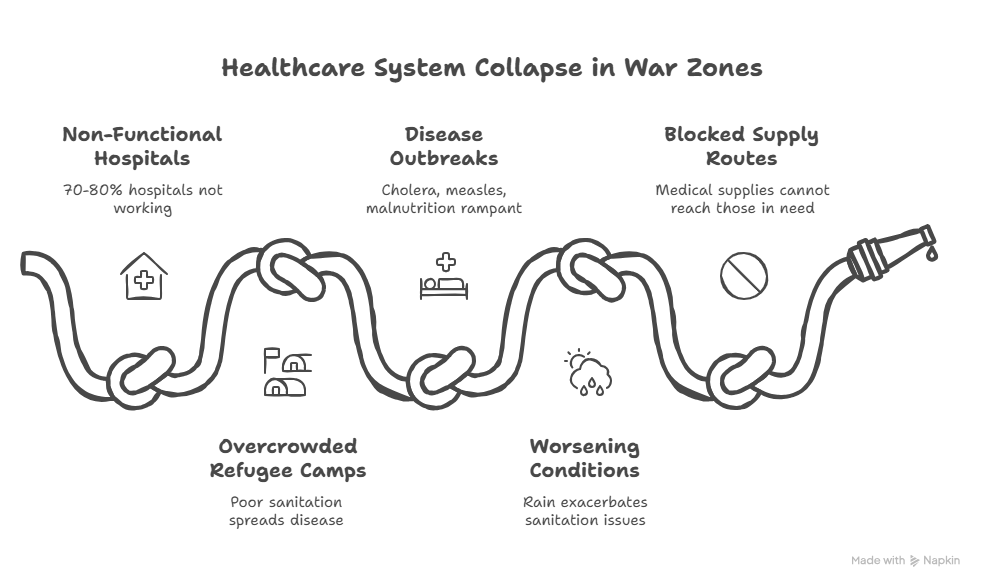
The health infrastructure across conflict zones is breaking down. Up to 70–80% of hospitals in areas of high conflict are now non-functional. Diseases like cholera, measles, and malnutrition-related infections flare in crowded camps with poor sanitation. The rainy season risks exacerbating outbreaks and limiting movement of medical supplies.
Water, sanitation, and shelter
In refugee camps and informal settlements, refugee camp conditions are dangerously inadequate. Many sites lack safe water, functional latrines, or proper shelter against extreme weather. Poor hygiene has already triggered cholera spikes in camps. Shelter gaps leave families exposed to cold, heat, and storms, compounding health and protection risks.
Protection vulnerabilities
Displacement heightens risks, especially for women, children, and marginalized groups. Reports show rising gender-based violence, forced recruitment into armed groups, child separation, and trafficking. In conflict zones, many displaced people travel without documentation, rendering them vulnerable to exploitation or detention.
What are the main barriers hindering aid delivery?
Security and access challenges
The continued fighting between the Sudanese Armed Forces (SAF) and the Rapid Support Forces (RSF) severely restricts humanitarian aid in Sudan. Convoys are blocked by checkpoints, attacked, or unable to pass through frontlines. The OCHA “Humanitarian Access Snapshot” documents that access deteriorated significantly by April 2025 due to threats, infrastructure damage, and insecurity. Numerous incidents show medical facilities bombed and NGO staff under attack.
In April 2025, the RSF launched assaults on Zamzam and Abu Shouk displacement camps, displacing up to 400,000 people and destroying vital infrastructure. These attacks not only displaced people again but also made aid workers targets.
Funding shortfalls and donor fatigue
Despite urgent appeals, the Sudan humanitarian response remains dramatically underfunded. The 2025 UNHCR global appeal sought over $1 billion, but as of late 2024, only 40% had been received. Meanwhile, IRC and other relief agencies warn that the total humanitarian needs in Sudan have reached $4.2 billion, with systemic gaps across sectors.
Donor fatigue is growing: multiple global crises (Gaza, Ukraine, others) are stretching budgets, while switching attention away from protracted crises like Sudan.
Logistical and supply chain constraints
Even when funding is available, delivering aid is a challenge. Damaged roads, seasonal flooding, collapsed bridges, and limited warehousing hamper supply chains. In many remote or besieged areas, relief must travel on foot or via air drops. These constraints often delay or block refugee support programs from reaching those in need.
Political and bureaucratic obstacles
Authorities or local powers sometimes withhold permits, restrict movement, or impose delays on NGOs hoping to import supplies or travel across frontlines. Some aid workers speak of a “culture of distrust” where governments scrutinize or obstruct humanitarian operations to control narratives. This kind of aid challenge is deeply frustrating for frontline responders.
How are agencies and communities responding?
International and UN-led efforts
Major agencies like UNHCR, WFP, UNICEF, WHO, and partner NGOs are implementing coordinated response plans across sectors—food, health, shelter, water, protection. (UNHCR operational reporting) They operate both inside Sudan and in host countries to provide support to refugees, IDPs, and returnees.
For operational continuity, UNHCR maintains presence in high-priority states and deploys remote monitoring in inaccessible areas. (unhcr.org) In refugee-hosting nations, regional plans project that an additional 1 million Sudanese refugees may arrive in 2025, bringing the total to nearly 5 million across borders. (reliefweb)
Local actors and community resilience
Local civil society groups, grassroots volunteers, and diaspora networks often serve as first responders—providing food, shelter, psychosocial support, and connections to formal aid. Their role often fills gaps when international actors cannot reach remote areas.
Sudanese communities display extraordinary refugee resilience: families share scarce resources, adapt shelters, and mobilize collective protection. These efforts complement and sometimes sustain formal refugee support programs.
Where gaps remain
Even with aid scaling up, coverage remains uneven. Many remote or frontline communities receive no assistance. Some sectors—especially protection, mental health, child services—are underfunded or deprioritized. In besieged areas, conditions worsen daily as aid convoys remain blocked.
What constitutes effective aid on the ground?
Cash assistance and market-based programs
Where local markets function, cash-based interventions allow displaced families flexibility to buy what they need most—food, medicine, hygiene items—while supporting local economies. These are often more efficient than in-kind aid, particularly in relatively stable zones.
Protection-first programming
Effective humanitarian interventions must integrate protection from the start. This includes safe spaces for women and girls, child protection services, legal aid, and family tracing. Aid that fails to protect vulnerable populations can do more harm than good in volatile settings.
Bridging to durable solutions
While the immediate priority is lifesaving support, sustainable programs like livelihood skills training, access to education, and agricultural recovery help displaced people rebuild dignity and independence. Such transitional interventions align with the AMEL Foundation’s long-term mission.
Coordination and flexibility
Humanitarian actors must remain agile. As frontlines shift, response plans must adapt. Unrestricted funding—less tied to narrow projects—lets agencies allocate resources where the crisis is most acute. Coordination across NGOs, governments, and local actors reduces gaps and duplication.
What can donors, supporters, and the global public do?
Giving wisely and verifying credibility
To maximize impact, donors should support organizations with track records, transparency, and local partnerships. The AMEL Foundation channels emergency and food security support through trusted local networks (see our emergency page and food security page). Donors should prefer unrestricted funding—allowing aid groups to respond flexibly to changing needs.
Advocacy, storytelling, and awareness
Giving money is essential—but spreading truth is critical. Sharing verified stories, raising global refugee awareness, and calling on governments to protect humanitarian access helps shift policy and funding priorities. Encouraging your policymakers to support UN appeals, safe corridors, and peace efforts can echo far beyond a single donation.
Avoiding harmful “helping” efforts
Well-meaning but uncoordinated donations (e.g., sending unsorted goods), voluntourism without local guidance, or sharing unverified content can harm operations and trust. Better to donate cash through vetted NGOs or mobilize informed advocacy.
Sustained support over short-term interest
Humanitarian crises require persistence. Donors must stay engaged even when media attention fades. Long-term partnerships, recurring gifts, and continuous advocacy keep life-saving programs afloat through crises like Sudan’s Refugee situation.
Conclusion: Hope Amid Crisis — Stand with Sudan
Sudan’s refugee crisis is not a distant event—it’s a current emergency of staggering magnitude. Millions are displaced, malnourished, traumatized, and struggling to survive under siege. The urgency is clear; yet so is the opportunity for action.
Despite unspeakable hardship, the resilience of Sudanese families beams through. They adapt, protect each other, and keep hope in small acts—sharing water, rebuilding shelters, teaching children in rubble. That spirit must be matched with global solidarity.Now is the moment to act: donate to effective organizations, push governments to fund and protect humanitarian corridors, and keep amplifying the stories and needs of displaced Sudanese. The AMEL Foundation stands ready to transform compassion into impact. Visit our emergency projects and food security efforts to learn how your support becomes lifeline.

Comments are closed