Updated: August 2026
When someone donates to humanitarian work in Sudan, one question matters almost immediately:
What can my donation actually support?
The answer is broader than a food parcel, bottle of water or box of medicine.
Humanitarian assistance involves getting the right support to people whose normal systems for meeting basic needs have been disrupted by conflict, displacement, disease, food insecurity and loss of livelihoods.
In 2026, 33.7 million people in Sudan require humanitarian assistance, including 17.3 million children. UNICEF reported that its own Sudan humanitarian appeal remained only 36% funded at the end of June, leaving a 64% funding gap.
Nearly 19.5 million people are facing Crisis-level or worse acute food insecurity, hundreds of thousands of children are expected to suffer severe acute malnutrition, and millions of people continue to live with disrupted access to healthcare, clean water and other essential services.
Against needs of this scale, an individual donation cannot solve Sudan’s humanitarian crisis.
But it can become part of a response that provides food, water, healthcare, child support and other practical assistance to families facing those conditions.
Understanding how that works helps donors make more informed decisions about where and how they give.
A Donation Supports a Response, Not Just an Item
Humanitarian fundraising is often presented in simple terms.
A donation buys food.
Another donation provides water.
Another helps a child.
Those descriptions can make humanitarian work easier to understand, but the reality is more complex.
Before a food basket reaches a family, food may have to be purchased, transported, stored, packed, allocated and distributed.
A water project may involve a pump, pipes, purification equipment, installation, transport, labour, maintenance and water-quality considerations.
A community medical activity may require qualified health workers, medicines, equipment, transport and a suitable location.
Humanitarian organizations also need systems for identifying people in need, documenting distributions, protecting beneficiary information, monitoring projects and responding to complaints.
Those functions are not separate from humanitarian assistance.
They are part of what makes responsible assistance possible.
This is why donors should think about their contribution not simply as purchasing an object, but as helping make a humanitarian service or programme possible.
Food Assistance Can Help Families Meet Immediate Needs
Food remains one of Sudan’s most urgent humanitarian needs.
The latest nationwide IPC analysis found that nearly 19.5 million people were experiencing Crisis-level or worse acute food insecurity between February and May 2026.
Conflict affects food access in several ways.
Families may be displaced from farms and jobs.
Markets may be disrupted.
Food prices can rise.
Transport routes may become unsafe.
People who previously supported themselves may suddenly lose both income and stored food.
Donations to food-security programmes can therefore support different forms of assistance depending on the location and programme.
One approach is the distribution of food baskets containing essential household foods.
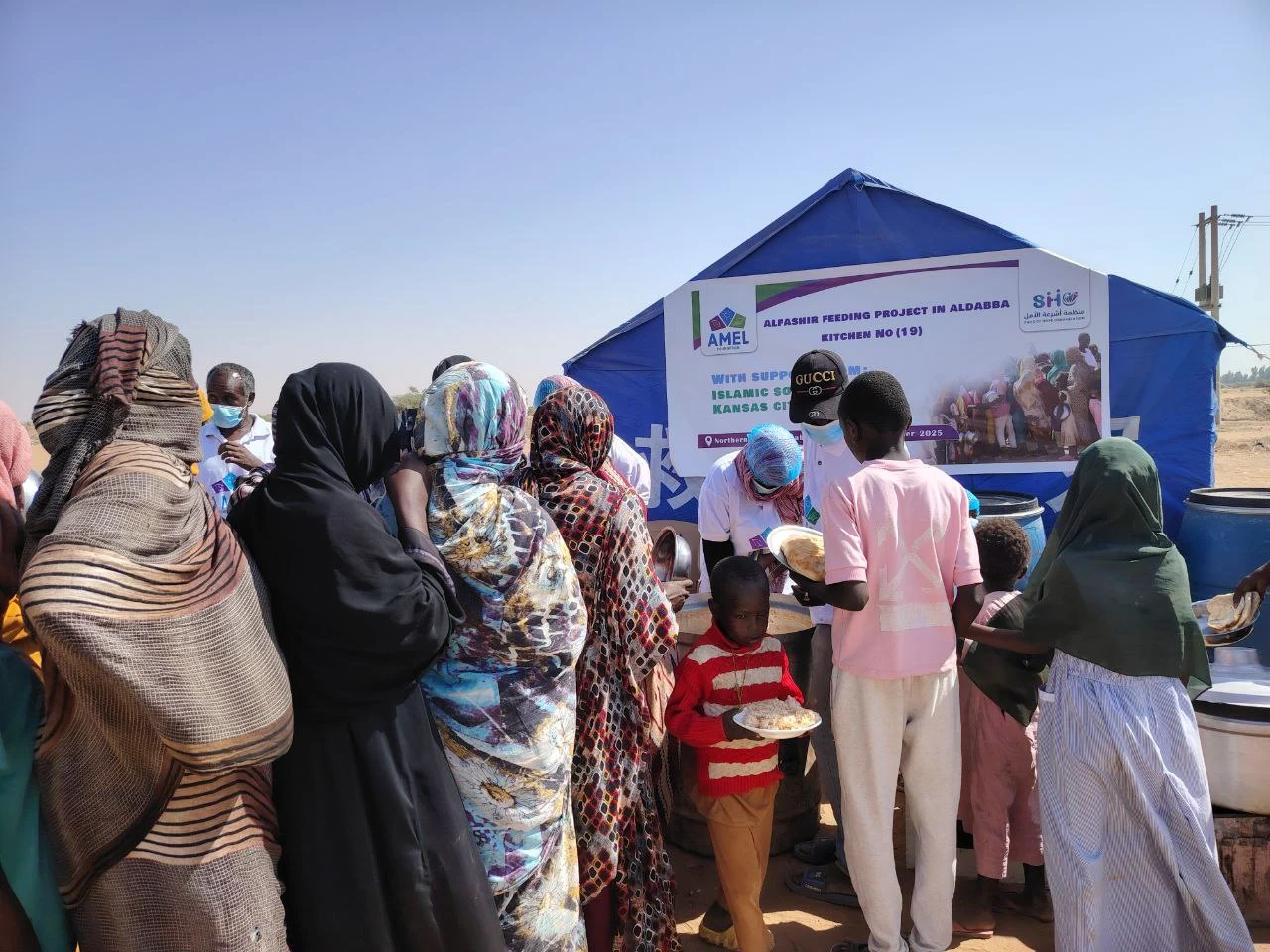
Another is the community-kitchen model, often known in Sudan as Takaya, where food is prepared collectively and hot meals are provided to families who may lack reliable food, cooking equipment or fuel.
Amel Foundation currently identifies Food Security as one of its public donation and programme areas. Its First Half 2026 Impact Report records both Ramadan food-basket distributions and community-kitchen assistance, including 2,355 food baskets and 87,000 meals during recorded activities in the first six months of the year.
The appropriate form of food assistance can change according to circumstances.
For one community, household food baskets may make sense.
For newly displaced families without reliable cooking facilities, prepared meals may be more practical.
That is why humanitarian programmes need enough flexibility to respond to actual conditions on the ground.
Donations Can Support Access to Clean Water
Water is another major need.
The May 2026 joint warning from WFP, FAO and UNICEF estimated that around 17 million people in Sudan lacked access to safe drinking water, while around 24 million lacked adequate sanitation.
For displaced families and communities with damaged infrastructure, water assistance can take several forms.
During an immediate emergency, humanitarian organizations may need to provide temporary water supplies.
In other situations, the stronger solution may be repairing a well, restoring a damaged pump, improving a water system or developing infrastructure that can provide more reliable access over time.
Amel currently lists Water as one of its public donation areas. Its documented 2026 response includes WASH and water projects, with its first-half reporting recording 3,600 WASH beneficiaries, including support connected to water wells and hygiene assistance.
Supporting water access can also contribute to public health.
Safe water, adequate sanitation and hygiene help reduce exposure to several waterborne and diarrhoeal diseases.
That does not mean a donor can claim that a particular contribution prevented a specific case of cholera.
Disease prevention depends on multiple factors.
But improving safe water and hygiene conditions addresses an important part of the risk.
Healthcare Donations Can Bring Basic Care Closer to Communities
Sudan’s healthcare system has been severely disrupted.
WHO reported in April 2026 that around 21 million people lacked adequate access to health services, while 37% of health facilities were non-functional.
That means healthcare needs exist far beyond hospitals treating conflict injuries.
Children still become sick.
Pregnant women still require care.
People still develop malaria and other infections.
Patients with chronic illnesses still require medication and monitoring.
Displaced families may find themselves far away from the health facilities they previously used.
Humanitarian healthcare support can therefore include primary care, medicines, medical campaigns, community health activities, referrals and other forms of basic assistance.
Amel Foundation identifies Healthcare as one of its current programme areas. Its First Half 2026 reporting records 1,082 health beneficiaries and describes free medical days intended to bring basic healthcare closer to vulnerable communities.
These activities should not be confused with replacing hospitals or providing every form of specialized treatment.
Community medical support fills particular gaps.
Sudan still needs functioning hospitals, clinics, laboratories, pharmacies and specialist services.
Donations Can Support Children Who Have Lost Stability
Children are carrying an enormous share of Sudan’s humanitarian crisis.
UNICEF estimates that 17.3 million children require humanitarian assistance in 2026.
Some have been displaced.
Some have lost parents or caregivers.
Millions remain outside school.
Many live in households struggling to afford food, medicine and other essentials.
Supporting vulnerable children therefore involves more than one type of assistance.
A child may need food.
They may need healthcare.
They may need education support.
They may need clothing or other basic necessities.
They may need a stable caregiver and protection.
For children who have lost one or both parents, longer-term support can be particularly important.
Amel’s current public programme portfolio includes an Orphans Program, while its internal programme documentation describes child-welfare support as including financial assistance, education support, psychosocial care and protection. Amel’s First Half 2026 reporting records 200 beneficiaries through its orphan sponsorship programme.
The purpose of responsible child support should not simply be to provide an occasional item.
It should help strengthen the environment around the child.
Education Can Also Be Part of Humanitarian Giving
Education may not seem as immediately urgent as food or medicine.
But Sudan’s crisis has kept millions of children away from school.
More than eight million children remained out of school in 2026, according to UNICEF.
For a child who has experienced conflict and displacement, returning to education can restore learning, routine and social connection.
Amel’s programme documentation identifies education support as including school-support initiatives, learning materials and assistance intended to help children continue their education during economic hardship.
Education donations can therefore contribute to a different stage of humanitarian response.
Emergency food may help a child today.
Education helps protect some of that child’s possibilities for tomorrow.
Both matter.
Livelihood and Training Support Can Help Families Move Beyond Repeated Assistance
Not every humanitarian programme needs to end with another distribution.
Where conditions allow, families may benefit more from opportunities to earn income again.
Conflict and displacement can destroy livelihoods even when people remain physically capable of working.
A farmer may lose access to land.
A small business may close.
A young person may have no opportunity to complete training.
A family that previously supported itself can become dependent on emergency assistance because the systems that allowed it to earn an income no longer function.
Amel’s public programme portfolio includes Training & Development, alongside its emergency-relief sectors.
Its internal programme documentation also identifies vocational training and skills-building among its development activities.
This represents an important difference between immediate relief and recovery.
Emergency assistance asks:
What does this family need to get through today?
Livelihood support asks:
What could help this family support itself again?
A humanitarian response often needs both.
Donations Can Support Families Forced to Flee
Displacement creates multiple needs simultaneously.
A family leaving home may suddenly require food, shelter, water, hygiene supplies, healthcare, clothing and protection.
Those needs also change over time.
During the first days of displacement, survival may be the priority.
After several months, families may require education, livelihoods and more sustainable access to services.
Amel currently maintains a specific public appeal connected to families displaced from Al Fasher.
Its campaign page describes support through community kitchens for displaced families in Al-Dabba, Northern State, with local implementation involving partners including Sails of Hope Organization. The campaign identifies food, basic healthcare, logistics and essential services among continuing needs.
This illustrates why emergency appeals can look different from long-term programmes.
They are responding to a particular population, place and moment.
Part of a Donation Supports Delivery
When a donor sees a photograph of a food distribution, the visible part of the programme is the food.
But the food did not arrive there by itself.
Humanitarian delivery can involve local transport, storage, volunteers or staff, packaging, supplier payments, coordination, documentation and monitoring.
In a conflict environment, additional planning may also be required around security and access.
These costs should not automatically be viewed as money “taken away” from beneficiaries.
Some operational costs are necessary precisely because assistance needs to reach beneficiaries safely and responsibly.
The more useful donor question is not:
“Did every dollar purchase an item?”
It is:
“Was the programme delivered efficiently, responsibly and with evidence that the intended assistance reached the people it was meant to serve?”
That is a much stronger test of humanitarian accountability.
Local Implementation Can Help Turn Donations Into Assistance
Blog 7 in this series explained why local organizations are important within Sudan’s humanitarian response.
The same principle applies to donations.
Money raised outside Sudan still has to become assistance inside Sudan.
That can require local suppliers, field teams, community volunteers and organizations that understand the communities where projects operate.
Amel’s current organizational model uses local implementation and partnerships in Sudan, including documented work with Sails of Hope Organization.
That relationship helps connect donor support raised through Amel with locally implemented humanitarian activities where project records identify Sails of Hope as the implementing partner.
The distinction remains important.
Amel and Sails of Hope are separate organizations, and project results should be attributed according to the documentation for the specific project rather than combining the two organizations’ work.
Donors Should Understand the Difference Between a Specific Campaign and Flexible Support
Not every donation operates in exactly the same way.
A donor may choose a specific programme such as food security, water, orphan support or an emergency appeal.
In that situation, the purpose of the campaign helps determine how the contribution is intended to be used.
Other forms of giving may provide an organization with greater flexibility to respond to changing humanitarian priorities, depending on the donation terms offered by that organization.
That flexibility can matter during a fast-moving emergency.
A community may urgently need food one month and water-system repairs the next.
New displacement may suddenly create needs somewhere else.
An outbreak may increase demand for health or WASH assistance.
Humanitarian organizations therefore need to balance donor intention with the ability to respond as conditions change.
Before donating, supporters should read the description of the campaign they are contributing to so they understand its intended purpose.
Be Careful With “Your $X Provides Y” Claims
Specific donation examples can be useful.
A donor naturally wants to know what $25, $100 or $500 might accomplish.
But humanitarian costs change.
Food prices fluctuate.
Fuel prices change.
Transport routes change.
Exchange rates move.
One location may cost much more to reach than another.
A water project suitable for one village may be completely different from what another community requires.
For that reason, highly specific statements such as “$50 always feeds a family for one month” should only be used when an organization has a current, verified cost model behind the claim.
Amel’s current website includes suggested donation-impact amounts for some food and water programmes.
For a long-term knowledge article like this one, however, the safer principle is to explain the types of support donations can fund rather than treating changing programme costs as permanent promises.
Campaign-specific amounts can be updated separately as prices and programmes change.
What Should Donors Look for After They Give?
Giving should not end at the payment confirmation page.
Donors should be able to learn what an organization is doing.
Good humanitarian communication can include programme updates, field photographs, beneficiary figures, reports and explanations of how projects are delivered.
The evidence will not always look identical.
A major infrastructure project may have budgets, photographs and completion documentation.
A food distribution may have supplier records, distribution lists and field reports.
A community activity may be documented through attendance information, photographs and narrative reporting.
What matters is that organizations make reasonable efforts to document their work and communicate honestly about what they know.
They should also acknowledge what they cannot verify.
Transparency is stronger than an impressive number that cannot be supported.
The Most Useful Donation Is Not Always the Most Dramatic One
Humanitarian giving often focuses on emergency moments.
A major displacement.
A famine warning.
A disease outbreak.
These moments deserve attention.
But humanitarian work also depends on less visible forms of support.
Keeping a community kitchen operating another month.
Repairing a water system.
Restocking basic medicines.
Helping a child remain in school.
Supporting a caregiver responsible for an orphan.
Training someone so they can begin earning income again.
Maintaining the systems that monitor and document those programmes.
None of these may make international headlines.
For the person receiving the assistance, they can still matter enormously.
What Your Donation Can Support
The most accurate answer is not one item.
A donation to humanitarian work in Sudan can contribute to a wider system of assistance.
Through Amel Foundation’s current programmes, donor support can be directed toward areas including food security, water and WASH, healthcare, orphan and child welfare, emergency response, education-related support, and training and development. Amel’s current public donation pages include Food Security, Water, Orphans and emergency appeals, while its broader programme portfolio also includes Healthcare and Training & Development.
The form that assistance takes should depend on the programme, the community and the conditions at the time.
That is why responsible humanitarian giving requires two things at once:
generosity from donors and accountability from organizations.
Sudan’s needs are too large for vague promises.
Donors deserve to know what they are supporting.
Communities deserve assistance designed around what they actually need.
And organizations have a responsibility to connect the two as clearly and honestly as possible.
Because a donation becomes meaningful not when it is made.
It becomes meaningful when it is turned into responsible assistance for someone who needs it.
Support Amel Foundation’s Humanitarian Response in Sudan
Amel Foundation supports food, water, healthcare, child welfare and other humanitarian and development programmes for vulnerable communities across Sudan.

Comments are closed