
Updated: August 2026
When people think about humanitarian aid, they may picture international organizations, convoys of trucks, warehouses filled with supplies or planes carrying emergency assistance.
All of those can be important.
But much of the work that makes humanitarian assistance possible happens much closer to the communities receiving it.
A local organization may know which neighbourhood has received new displaced families overnight. Community volunteers may know that a water point has stopped operating before the problem appears in a formal report. Local health workers may understand which clinic is still functioning, which roads are accessible and which families have been unable to reach services.
In Sudan, that local presence has become particularly important.
Conflict has repeatedly disrupted roads, supply chains, healthcare, communications and humanitarian access. Some communities have experienced long periods during which conventional aid operations have struggled to reach them.
At the same time, Sudanese organizations, community groups and volunteer networks have continued responding inside their own communities.
UNICEF reported that local mutual-aid groups supported communal kitchens serving around 25,000 people across targeted areas of North Darfur and South Kordofan during the first half of 2026. UNICEF described these community-led groups as having demonstrated an ability to provide urgently needed assistance in areas where humanitarian access remained constrained.
This is part of a wider humanitarian approach often described as localization.
But localization means more than simply asking a local organization to distribute supplies.
At its strongest, it means recognizing local organizations and communities as partners in deciding, designing, delivering and improving humanitarian response.
What Does “Localization” Mean in Humanitarian Aid?
Localization refers broadly to giving local and national actors a stronger role in humanitarian action.
That can include national NGOs, community-based organizations, women-led groups, volunteer networks, local health organizations, community committees and other structures already rooted in the areas experiencing crisis.
International humanitarian policy has increasingly recognized the importance of this approach.
OCHA’s localization guidance reflects a wider humanitarian commitment to increase the proportion of humanitarian funding reaching local and national actors and to strengthen their role throughout humanitarian planning and response.
The idea is not that international organizations should disappear.
Large organizations can bring major funding, global supply chains, technical expertise, specialist services and the capacity to operate at scale.
Local actors bring something different.
They are often already there.
They know the communities.
And in a crisis as geographically complex and fast-changing as Sudan’s, that knowledge can determine whether assistance reaches the right people at the right time.
Local Organizations May Already Be Present When a Crisis Escalates
International humanitarian operations often require significant logistics.
Staff have to travel.
Supplies have to move across borders or between states.
Warehouses, vehicles and permissions may be required.
Security conditions have to be assessed.
When roads close or fighting intensifies, those systems can become difficult to maintain.
Local organizations and community networks may already be physically present.
Sudan offers clear examples.
Since the conflict began in 2023, locally organized groups have operated communal kitchens, supported health services, distributed essential supplies and responded to displacement inside communities where larger organizations have sometimes struggled to maintain consistent access.
Research published by the CALP Network in July 2026 found that Sudanese community groups — including Emergency Response Rooms, community kitchens, women’s cooperatives and agricultural collectives — had delivered lifesaving assistance in areas where conventional humanitarian organizations struggled to operate.
UNICEF similarly describes local mutual-aid groups as a critical frontline mechanism, particularly where consistent humanitarian access and basic public services have been disrupted.
The importance of being present before a crisis reaches its worst point is difficult to overstate.
A local organization does not necessarily need to first discover where the community is.
It may already be part of it.
Local Knowledge Can Make Humanitarian Response More Precise
Humanitarian emergencies create large numbers.
Millions displaced.
Millions requiring food.
Millions requiring healthcare.
But assistance is eventually delivered household by household and community by community.
That requires much more detailed knowledge.
Which families recently arrived?
Who is elderly?
Which households include people with disabilities?
Which water source is working?
Which clinic still has medicines?
Which market has food available?
Which road can currently be used safely?
What time should a distribution take place?
Which community leaders need to be consulted?
What local tensions might make one distribution site safer than another?
Local organizations can often provide this kind of contextual knowledge because their staff and volunteers live within or close to the communities they serve.
UNDP’s Sudan crisis approach specifically emphasizes partnerships with local actors because local ownership can improve the effectiveness, efficiency, accountability and sustainability of interventions while helping organizations understand complex political, social and cultural environments.
That does not mean local organizations automatically know everything.
Needs still have to be assessed.
Targeting still has to be fair.
Data still has to be verified.
But local knowledge can make those processes stronger.
Communities Often Know Their Priorities Before Outside Organizations Do
One of the biggest differences between locally led response and purely externally designed aid is who defines the problem.
A humanitarian organization may arrive with funding for food.
But the community may have enough food in the local market and urgently need cash to buy it.
A donor may want to fund water trucking.
But a local organization may know that repairing one damaged pump would provide a more sustainable solution.
A programme may plan to distribute supplies in one neighbourhood while newly displaced families are arriving somewhere else.
When communities participate in decision-making, humanitarian assistance can adapt more quickly.
This is one reason flexible approaches such as group cash transfers have gained attention in Sudan.
CALP’s 2026 research found that giving flexible funding to existing community groups allowed those groups to respond to priorities identified by their own communities rather than imposing only externally selected activities.
That principle applies beyond cash.
Community participation can influence what is provided, where it is provided and how it is delivered.
Local Organizations Can Help Aid Adapt as People Move
Sudan’s humanitarian geography changes constantly.
Families may flee one town and arrive in another.
An area that was accessible last month may become difficult to reach.
A host community may suddenly receive thousands of displaced people.
A water system may become overwhelmed.
A functioning clinic may begin receiving patients from several neighbouring areas.
That means humanitarian programmes designed around a static map can quickly become outdated.
Local actors can provide faster information about what is changing.
This does not replace formal humanitarian assessments.
Instead, it can make those assessments more responsive.
In places like North Darfur and Kordofan, UNICEF has repeatedly described humanitarian operations being affected by blocked routes, insecurity and restrictions on movement. At the same time, local partners and community-based systems have helped sustain health, nutrition, WASH, protection and food assistance.
In a crisis where needs move with people, humanitarian delivery also has to move.
Local Procurement Can Shorten the Distance Between Funding and Assistance
Local humanitarian response is not only about personnel.
It can also involve where supplies are purchased.
Where markets are functioning, buying suitable goods locally can reduce the need to transport everything across long distances.
Food may be purchased from local farmers or wholesalers.
Transport can be arranged locally.
Services can be contracted from businesses already operating in the area.
This can shorten supply chains and support local economic activity.
But local procurement is not automatically the best option in every situation.
If markets have collapsed, supplies are unavailable or prices are highly distorted, humanitarian organizations may need to bring commodities from elsewhere.
Good humanitarian programming therefore requires market assessment rather than assuming either imported or locally purchased assistance is always superior.
The larger principle remains important:
the closer humanitarian supply chains can operate to functioning communities and markets, the more opportunities there may be to keep humanitarian spending within the local economy.
Community Kitchens Show What Local Response Can Look Like
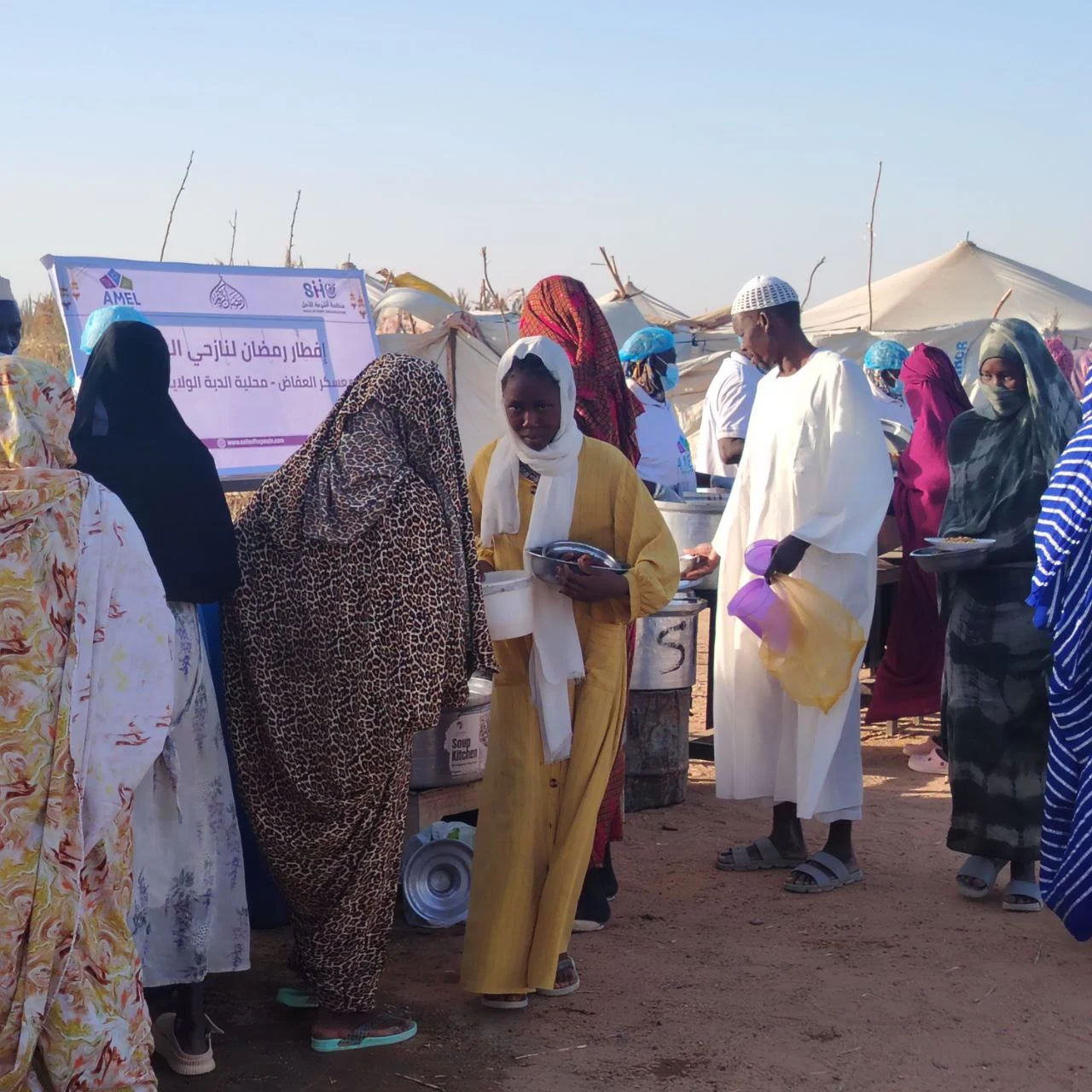
Sudan’s communal kitchens provide one of the clearest examples of community-led humanitarian response.
When households lose income, cooking fuel, food supplies or even access to kitchens, communal food preparation can allow communities to pool labour and resources.
Local volunteers may organize ingredients.
Others cook.
Others identify vulnerable households or help distribute meals.
These kitchens are sometimes referred to as Takaya, drawing on a long tradition of communal food support.
During the current crisis, this model has become an important emergency mechanism in several parts of Sudan.
UNICEF continued supporting local mutual-aid groups operating communal kitchens in North Darfur and South Kordofan in early 2026. Around 25,000 people were supported through these kitchens in targeted areas, and UNICEF noted that the kitchens could also function as platforms connecting communities with other forms of assistance.
The model demonstrates something important about localization.
Local communities are not always waiting for a humanitarian system to arrive.
In many cases, they have already started responding.
External support can then strengthen something that already exists.
Local Organizations Can Build Trust That Aid Systems Need
Humanitarian programmes depend on information.
Organizations need to know who requires assistance.
Communities need to understand what assistance is available.
People need ways to ask questions or report problems.
None of that works particularly well without trust.
Local staff may speak the same language or dialect as the communities they serve.
They may understand local leadership structures.
They may know how information normally spreads.
They may understand why one group is reluctant to register for assistance or why another community distrusts a particular distribution method.
This can make communication more effective.
UNICEF’s 2026 Sudan response describes the use of trusted community structures and local-language communication to maintain community engagement despite insecurity, displacement and weak communications infrastructure.
Trust, however, should never replace formal accountability.
A community may trust an organization and still need a safe way to make a complaint.
That is why good local humanitarian response needs both relationships and systems.
Local Does Not Automatically Mean Accountable
Localization should not be romanticized.
A local organization can have strong community knowledge and still require stronger financial systems.
A volunteer group can respond quickly but need better safeguarding procedures.
An organization may have excellent operational access but limited monitoring capacity.
Another may require support with procurement, documentation, data protection or donor reporting.
International organizations face these problems too.
The answer is not to assume that either local or international organizations are automatically better.
The answer is to build partnerships in which local access and knowledge are supported by strong humanitarian standards and accountability systems.
That can include:
- clear budgets and procurement procedures;
- beneficiary registration and monitoring;
- safeguarding and prevention of sexual exploitation and abuse;
- complaints and community-feedback mechanisms;
- financial documentation;
- donor reporting;
- protection of beneficiary data;
- coordination with other humanitarian actors.
Capacity building should therefore be understood as partnership development, not as an assumption that international organizations possess all expertise while local organizations possess none.
Both sides can contribute different capabilities.
Community Feedback Is Part of Localization
One of the most important forms of local participation is also one of the simplest:
asking people whether assistance is actually working.
Humanitarian programmes can make mistakes.
A distribution point may be too far away.
A registration process may exclude certain households.
Information may not reach everyone.
A water point may be difficult for someone with a disability to access.
Supplies may not match what a community needs most.
Feedback allows programmes to change.
During the first half of 2026, UNICEF-supported accountability mechanisms in Sudan received more than 143,000 individual feedback cases, alongside hundreds of collective community feedback reports representing the views of approximately 2.7 million people across all 18 states.
Communities raised issues involving cash assistance, healthcare, water, food, nutrition, education and protection.
This demonstrates that local participation does not end when aid is distributed.
Affected communities should also have a voice in what happens afterwards.
Local Organizations Still Need Reliable Funding
Local response can be highly effective and still remain financially fragile.
The communal-kitchen example from 2026 illustrates this.
UNICEF reported that funding supporting local mutual-aid groups in targeted parts of North Darfur and South Kordofan was exhausted at the end of March, even though the groups had demonstrated significant ability to reach vulnerable communities in access-constrained areas.
Resuming that support was identified as a priority.
This exposes one of the contradictions within localization.
Humanitarian organizations frequently recognize the importance of local responders.
But local actors may still struggle to access predictable funding.
Short-term grants can allow a programme to operate for several weeks or months, after which the community may again face uncertainty.
Real localization therefore requires more than praise for local organizations.
It requires resources.
International and Local Humanitarian Organizations Are Most Powerful When Their Strengths Connect
The choice should not be framed as:
international aid or local aid.
Both can be necessary.
In February 2026, for example, a UN inter-agency convoy delivered hundreds of tonnes of food alongside health, nutrition, WASH and education supplies into Dilling and Kadugli in South Kordofan after communities had been largely cut off from major assistance.
Operations of that size require major logistics.
But once assistance enters a community, local partners, health workers, volunteers and community structures become crucial to turning supplies into actual services.
Large humanitarian systems can mobilize funding and commodities.
Local organizations can help connect those resources to households.
The strongest response often happens when those capacities reinforce each other.
Amel Foundation’s Local Delivery Model
This same principle is relevant to how Amel Foundation works in Sudan.
Amel Foundation is a U.S.-registered nonprofit that raises support and engages donors, partners and communities, particularly in the United States. Its work in Sudan is delivered through field teams, local partnerships and community-based networks. Sails of Hope Organization is identified in Amel’s current organizational knowledge as a major local implementation partner, while the two organizations remain separate entities.
Current Amel materials describe Sails of Hope as supporting local field implementation across areas including food security, health, protection, WASH and community support. Amel’s internal communication guidance specifically recommends describing work as being “supported by Amel Foundation and implemented locally with Sails of Hope” when the relevant project records support that attribution.
That wording matters.
Amel Foundation and Sails of Hope should not be presented as the same organization.
Not every Amel project should automatically be attributed to Sails of Hope, and not every Sails of Hope project should automatically be described as funded by Amel. Amel’s internal verification guidance explicitly requires project-level attribution rather than combining the organizations’ results.
Where the partnership is documented, however, the model connects two parts of humanitarian response.
Amel Foundation helps mobilize donor and institutional support.
Local implementation helps turn that support into activity inside Sudan.
What Local Delivery Looks Like in Practice
Amel’s documented programme portfolio provides examples of the kinds of humanitarian activities that can be delivered through local networks.
The Foundation’s current programme areas include food distributions and community kitchens, water and WASH activities, free medical days and other healthcare support, protection and community care, orphan support, education-related activities and seasonal humanitarian programmes.
During the first half of 2026, Amel’s impact reporting recorded activities including Ramadan food assistance, community kitchens, Qurbani distributions, water and WASH support and free medical days.
The significance of local delivery is not simply that someone is physically available to hand over assistance.
Field implementation can involve identifying appropriate locations, coordinating volunteers, working with suppliers, organizing distributions, documenting activity, responding to community concerns and adapting plans as conditions change.
Those processes are part of humanitarian delivery too.
Local Partnership Should Strengthen Accountability, Not Replace It
Working locally does not reduce the need for documentation.
It increases its importance.
Donors supporting work thousands of miles away need to understand what happened to their funds.
Organizations need to know who was reached.
Communities need ways to report problems.
Programme managers need evidence that activities actually occurred.
Amel’s own internal partnership guidance recognizes this distinction. It advises that local partnership should be used as evidence of access and context only when supported by project records, and that accountability should be demonstrated through the documentation actually available — such as trackers, receipts, field photographs, distribution lists, narrative reports and approved monitoring records.
That is the more credible way to talk about localization.
Not:
“Local organizations can always reach everyone.”
But:
“Local organizations can provide important access, knowledge and implementation capacity, and that work should still be documented, monitored and accountable.”
Why Localization Matters for Sudan’s Humanitarian Future
Sudan’s humanitarian crisis will not be resolved through emergency distributions alone.
Communities will eventually need functioning healthcare systems.
Schools will need to reopen.
Water infrastructure will need repair.
Businesses and agriculture will need to recover.
Families will need livelihoods.
Displaced people will need conditions that allow safe and sustainable return or settlement.
Local organizations will remain important throughout that process because they will still be there after a particular emergency grant ends.
UNDP’s crisis approach in Sudan therefore links humanitarian response with recovery and emphasizes strengthening local actors and community structures as part of building longer-term resilience.
Localization is ultimately about more than finding a faster way to distribute aid.
It is about ensuring that humanitarian response does not create a system that disappears as soon as outside organizations leave.
The People Closest to a Crisis Are Part of the Response
Sudan’s humanitarian emergency has shown what communities can do under extraordinary pressure.
Local organizations have operated services.
Volunteers have organized kitchens.
Health workers have continued treating patients.
Community groups have identified needs and supported displaced families.
International organizations have brought funding, supplies, specialist expertise and large-scale humanitarian capacity.
Neither side alone can meet Sudan’s enormous needs.
The strongest model is partnership.
A humanitarian system that listens locally can better understand what communities need.
A system that funds local actors can help existing responses continue.
A system that combines local access with strong accountability can build greater trust.
And a system that strengthens rather than replaces community capacity can leave something behind after the emergency programme ends.
For Sudan, that matters.
Because the people closest to the crisis are not only people humanitarian organizations are trying to reach.
They are also part of the humanitarian response itself.
How Amel Foundation Works Through Local Partnership
Amel Foundation supports humanitarian programmes in Sudan through partnerships, field teams and community-based networks, including documented local implementation with Sails of Hope Organization.

Comments are closed