
Updated: August 2026
When a school closes, the first loss is easy to see.
Children stop attending lessons.
They miss mathematics, languages, science and the opportunity to progress from one grade to the next.
But during a humanitarian crisis, education does much more than deliver a curriculum.
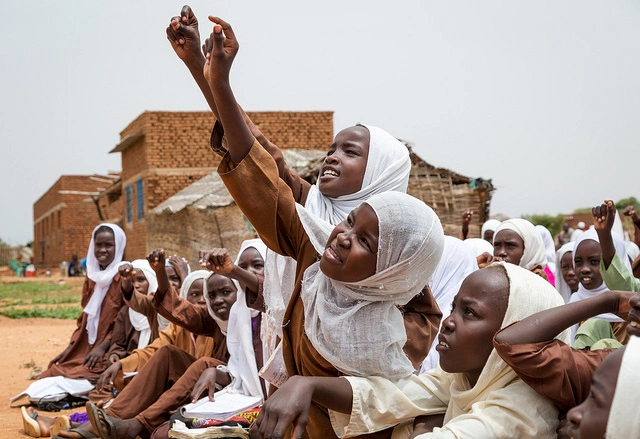
A functioning school can give a child routine after displacement, regular contact with trusted adults, connection with other children and a place where protection, psychosocial or other needs may be noticed. Learning can also give children something conflict repeatedly takes away: a sense that life still has a future.
That is why Sudan’s education crisis cannot be measured only by the number of lessons children have missed.
As of 2026, at least eight million school-aged children in Sudan remained out of school, while nearly half of the country’s school buildings were no longer functioning as classrooms. The most severe disruptions were concentrated in Darfur and conflict-affected parts of Kordofan.
For millions of children, the question is therefore no longer simply whether they are falling behind academically.
It is what prolonged separation from education could mean for the rest of their childhood.
Sudan Is Facing a Learning Crisis on an Extraordinary Scale
Sudan’s education system was under pressure long before the current conflict.
Poverty, instability, COVID-19 disruptions and previous school closures had already left millions of children outside formal education.
The conflict that began in April 2023 deepened those challenges dramatically.
By May 2026, UNICEF reported that more than eight million children remained out of school. Nearly half of all school buildings nationwide were no longer being used as classrooms because of damage, closure, occupation or use as shelters for displaced families.
In Darfur alone, UNICEF estimates that more than three million of the region’s nearly four million school-aged children are currently out of school.
Those figures represent more than an interruption to one school year.
Some Sudanese children have now experienced repeated educational disruptions over several years.
A child who was already affected by pandemic-related school closures may later have experienced political instability, conflict, displacement and another prolonged period outside the classroom.
The longer that continues, the harder returning can become.
What Does a Child Lose When Education Stops?
The obvious answer is learning.
But it is not the only answer.
In an emergency, education can provide structure around a child’s day.
There is a place to go.
There are adults responsible for teaching and supervision.
There are classmates.
There are predictable activities.
There is a distinction between morning and afternoon, weekday and weekend, one term and the next.
For a child whose home, neighbourhood or family life has been disrupted by conflict, that routine can matter.
UNICEF describes education in emergencies as a lifeline because children affected by crises may already have lost homes, loved ones, healthcare, food, safety and a sense of normality. Access to education can restore some continuity while helping protect their future.
The loss of school can therefore deepen the instability children are already experiencing outside it.
Education Can Help Restore a Sense of Normality After Displacement
Displacement changes almost every part of a child’s environment.
A family may move to another neighbourhood, state or displacement site.
The child may lose familiar teachers and friends.
Their home may change.
Their parents may lose employment.
Their family may be sharing temporary accommodation with relatives or strangers.
Food, water and healthcare may become less predictable.
In that environment, returning to learning can provide one of the few regular parts of the week.
UNICEF-supported safe spaces in Sudan have combined learning, play and psychosocial support for children affected by conflict and repeated displacement. In Gedaref, for example, children who had fled fighting were able to access spaces designed for learning and recovery after years of instability.
In White Nile State, child-friendly spaces have similarly provided children in displacement settings with structured activities, play and psychosocial support.
These initiatives demonstrate why education during a crisis should not be understood only as textbooks and examinations.
For some children, a learning space is also a place to begin feeling like a child again.
Schools Can Also Be Places of Protection
Teachers and school staff interact with children regularly.
That gives education systems an important protective role.
A teacher may notice when a child suddenly stops attending.
They may see signs that a child is struggling emotionally.
Schools can connect families with services, create safer environments for children during the day and provide information about health, hygiene and protection.
When children remain outside education for long periods, some of those protective connections disappear.
UNICEF warns that the longer Sudanese children remain out of school, the greater the risk that some will never return. Prolonged exclusion also leaves children more exposed to threats including recruitment by armed groups, gender-based violence and, particularly for girls, child marriage.
Education does not eliminate those risks.
But removing children from structured learning environments can remove one layer of protection at the same time that conflict is creating many others.
Girls May Face Additional Barriers to Returning
Sudan’s education emergency does not affect every child in exactly the same way.
Girls can face particular challenges.
A displaced family experiencing severe economic hardship may have limited resources for transport, school supplies or fees where applicable.
Girls may take on greater domestic or caregiving responsibilities.
Safety concerns can make travelling long distances to school difficult.
Where sanitation facilities are inadequate, adolescent girls may face additional barriers to attendance.
And prolonged school closure can increase the risk that some girls leave education permanently.
UNICEF specifically identifies child marriage and gender-based violence among the risks facing girls who remain out of education for long periods.
This matters because the longer a girl stays outside school, the more difficult re-entry can become as family circumstances and social expectations change.
Reopening a school is therefore only one part of the solution.
Children also have to be able to return safely and realistically.
Schools Themselves Have Been Affected by Conflict
Children cannot return to classrooms that are no longer safe or functional.
Sudan’s conflict has damaged education infrastructure directly.
In August 2026, UNICEF told the United Nations Security Council that more than 67 attacks on schools had been verified across Sudan since the adoption of Security Council Resolution 2736 in 2024, while more than 154 instances of military use of schools had been reported.
The consequences can be immediate.
In March 2026, reported drone attacks struck a secondary school and nearby healthcare facility in Shukairi village in White Nile State. At least eight students and a health worker were reported killed, others were injured, and schools in the locality subsequently closed.
Other school buildings have been damaged, looted or converted into temporary shelters for displaced families.
This creates a painful humanitarian dilemma.
Families fleeing conflict need somewhere safe to sleep.
But when classrooms become emergency shelters for long periods, children lose learning spaces.
The same building may therefore represent two urgent needs at once: shelter for displaced families and education for children.
Resolving that tension requires adequate alternatives for both.
Displacement Can Make One School Closure Follow Another
A child can also lose education even when their original school remains standing.
If the family is forced to flee, the school may simply become unreachable.
The child may arrive in a new community where classrooms are already overcrowded.
Documents may have been left behind.
The curriculum or school calendar may be different.
Teachers may not have enough materials.
The family may expect to move again.
This repeated disruption can make educational continuity extremely difficult.
One example comes from Central Darfur.
UNICEF documented Al Zahra Primary School in Rokero, where classrooms serve around 1,200 students during the day, including 400 internally displaced children, before becoming shelter for displaced families at night.
The same classrooms are therefore supporting two different consequences of the conflict.
They provide education during the day and shelter after classes end.
That is an extraordinary example of community adaptation.
It also shows how much pressure Sudan’s schools are carrying.
Falling Behind Is Not Just About Missing a Year
Learning loss accumulates.
A child who misses several months of mathematics may struggle when they return to a grade that assumes those skills are already understood.
A child who has had little opportunity to read may lose fluency.
Younger children may miss foundational literacy and numeracy at precisely the stage when those skills are normally built.
Older children may become too old for the grade they last attended.
As the gap grows, returning to a conventional classroom can become intimidating.
This is why education responses in emergencies often include remedial learning, accelerated programmes, alternative learning spaces and remote-learning options, rather than assuming every child can simply return to the exact point where formal schooling stopped.
Sudan’s Primary Education Emergency Support Project, for example, has been designed to support reopened schools while also reaching out-of-school children through remedial programmes, remote learning and teacher support.
The objective is not merely reopening buildings.
It is helping children actually resume learning.
Teachers Are Part of the Education Emergency Too
An education system depends on teachers.
But teachers live through the same conflict as everyone else.
They can be displaced.
Their homes may be damaged.
Their salaries may be interrupted.
Transport may become unsafe.
They may have families experiencing food insecurity or healthcare problems.
Some schools may reopen without enough teachers.
Others may have teachers but lack textbooks, furniture, electricity or basic classroom supplies.
Supporting education therefore requires more than repairing walls.
It requires keeping teachers connected to the system and giving them the resources to teach children whose educational experiences and emotional needs may be very different from before the conflict.
In Gedaref, UNICEF-supported school grants have helped reopened schools address urgent classroom and school-management needs while encouraging children to return to learning.
That kind of support may seem less dramatic than emergency food or medicine.
But without teachers and functioning classrooms, reopening education cannot last.
Education Can Support Emotional Recovery
Children affected by conflict may experience fear, grief, displacement and repeated uncertainty.
A classroom cannot erase those experiences.
But a safe learning environment can provide routine, supportive adults, interaction with other children and structured activities.
That is why education and psychosocial support often overlap in humanitarian responses.
During the first half of 2026, UNICEF and partners reported reaching 1.3 million children with education services while providing mental-health and psychosocial support to approximately 940,700 children and family members.
The services are distinct, but the broader principle is important.
Humanitarian education is not simply an attempt to preserve academic performance during war.
It is part of helping children continue developing socially and emotionally while the world around them remains unstable.
There Are Signs That Learning Can Continue
Sudan’s education crisis is enormous, but it is not a story only of closure.
Schools have reopened in some areas.
Communities continue teaching children under extremely difficult circumstances.
Humanitarian organizations are supporting alternative learning spaces and school rehabilitation.
And major parts of the education system continue operating where conditions allow.
In April 2026, UNICEF supported the national examinations for 544,200 students across more than 3,000 examination centres despite conflict and access constraints.
In May, UNICEF and partners announced a new programme intended to help more than 328,000 conflict-affected children return to learning, particularly in areas heavily affected by the crisis.
By the end of June, UNICEF reported reaching 1.3 million children with education services during 2026.
These numbers do not remove the scale of the problem.
Eight million children remain out of school.
But they demonstrate something important.
Even during conflict, restoring learning is possible when safe access, funding, teachers, communities and education partners come together.
Why Education Matters to Sudan’s Future Recovery
The consequences of the education crisis will not end when fighting stops.
A country recovering from conflict needs doctors, nurses, engineers, teachers, technicians, business owners, farmers, civil servants and community leaders.
Many of the people who would eventually take those roles are children today.
If millions spend years outside education, Sudan will eventually face a second crisis: a generation entering adulthood after prolonged disruption to learning.
UNICEF warns that lost learning can contribute to long-term marginalization, poverty and food insecurity.
Education is therefore both an immediate humanitarian need and a long-term recovery investment.
Keeping a child learning today helps preserve possibilities for that individual child.
At scale, it also helps preserve Sudan’s future human capacity.
How Amel Foundation’s Work Connects to Education
Education is included among Amel Foundation’s identified humanitarian and development programming areas in Sudan.
In its organizational programme documentation, Amel Foundation describes education activities as including school-support initiatives, provision of learning materials and support intended to help children continue their education despite economic hardship. Its child-welfare and orphan programming also identifies education support alongside financial assistance, psychosocial care and protection.
It is important not to overstate the scale of that work.
Amel’s available First Half 2026 impact reporting provides specific beneficiary totals for areas such as food assistance, WASH, health and orphan sponsorship, but it does not provide a comparable standalone 2026 education beneficiary figure.
For that reason, education should currently be described as an area within Amel’s broader programming rather than presented as one of its largest quantified 2026 responses.
That can change as stronger project-level education documentation becomes available.
The wider principle, however, fits Amel’s humanitarian approach: supporting children during Sudan’s crisis requires attention not only to immediate survival, but also to the systems that allow them to continue developing.
Education Should Not Have to Wait Until the Emergency Is Over
Food can feel more urgent than a textbook.
Medicine can feel more urgent than a classroom.
Safe water can feel more urgent than an examination.
In an immediate emergency, those priorities can be lifesaving.
But humanitarian crises like Sudan’s can last for years.
If education is postponed until everything else has been resolved, a child can lose a significant part of their childhood before returning to school.
That is why education is considered part of humanitarian response rather than something that begins only during reconstruction.
Children need food and education.
Healthcare and education.
Protection and education.
Safe water and education.
These needs are not competing descriptions of what a child requires.
Together, they describe childhood.
What Sudanese Children Risk Losing Beyond the Classroom
Sudan’s education statistics are alarming.
Eight million children remain out of school.
Nearly half of school buildings are no longer functioning as classrooms.
Schools have been damaged, attacked and repurposed as shelters.
But the greatest risk is not simply the number of missed school days.
Children risk losing routine.
They risk losing contact with teachers and friends.
They risk losing safe spaces.
Some risk greater exposure to violence, exploitation, recruitment or early marriage.
Repeated displacement can make returning more difficult.
Years of interrupted learning can make educational gaps harder to repair.
And Sudan itself risks losing part of the education and skills of an entire generation.
The response must therefore do more than reopen school gates.
Children need safe schools.
Teachers need support.
Damaged classrooms need rehabilitation.
Displaced children need flexible ways back into learning.
Girls need conditions that allow them to return safely.
Children who have fallen behind need opportunities to catch up.
And education itself must remain protected from conflict.
Because during an emergency, a classroom is not only a place where a child prepares for an exam.
It is one of the places where a child can begin preparing for life after the crisis.
Supporting Children and Families in Sudan
Amel Foundation supports humanitarian and development programmes for vulnerable communities in Sudan, including child welfare and education-related support.

Comments are closed