
Updated: August 2026
Leaving home does not always mean leaving your country.
For millions of Sudanese people, conflict has forced them to move from one town, village or state to another while remaining inside Sudan’s borders.
They are known as internally displaced persons, or IDPs.
The distinction may sound technical, but it matters. A person who crosses an international border because of conflict or persecution may become a refugee or asylum seeker. An internally displaced person has been forced to flee home but remains inside their own country.
Under the United Nations Guiding Principles on Internal Displacement, internally displaced persons are people who have been forced or obliged to leave their homes, including because of armed conflict, generalized violence, human rights violations or disasters, without crossing an internationally recognized state border.
In Sudan, that definition now applies to millions of people.
The International Organization for Migration’s Displacement Tracking Matrix recorded approximately 8.62 million internally displaced people across all 18 states in July 2026. More than half — around 55% — were children under 18.
But understanding Sudan’s displacement crisis requires looking beyond that number.
Becoming displaced can mean losing a home, income, school, healthcare, community networks and access to food or water at the same time. Some families have been forced to move more than once. Others are now returning home, only to find damaged houses and weakened services.
Internal displacement is therefore not simply about where someone lives.
It is about what happens when the systems that once made everyday life possible suddenly disappear.
What Is the Difference Between an IDP and a Refugee?
The simplest difference is the border.
An internally displaced person remains inside their country.
A refugee has crossed an international border and meets the relevant legal definition for refugee protection.
Sudan currently has both populations.
Millions have been displaced within Sudan, while millions of others have crossed into neighbouring and other countries since the conflict began.
As of early August 2026, UNHCR recorded approximately 3.65 million newly arrived refugees and asylum seekers outside Sudan in connection with the crisis since April 2023.
These populations may have experienced similar violence or loss, but their legal and humanitarian circumstances differ.
Refugees have crossed into another country and may receive protection and assistance through the host country and international refugee system.
IDPs remain under the jurisdiction of their own country.
The United Nations Guiding Principles emphasize that internally displaced people retain the same rights and freedoms as other people in their country and should not face discrimination because of their displacement.
How Large Is Sudan’s Internal Displacement Crisis in 2026?
According to IOM’s July 2026 Displacement and Return Snapshot, 8,622,801 internally displaced people were recorded across 185 localities in all 18 states of Sudan.
Approximately 55% were children.
At the same time, IOM recorded almost 4.93 million returnees, including people who had returned after internal displacement and others returning from abroad.
This makes Sudan’s displacement picture more complicated than a single rising or falling number.
There are several movements happening at once:
Some people remain displaced.
Some are newly fleeing violence.
Some have been displaced multiple times.
Some are returning to their places of origin.
Others may cross international borders.
That means Sudan’s displacement map can change even while the humanitarian crisis remains severe.
Why Has the Number of IDPs Fallen?
Sudan’s recorded IDP population has declined from its earlier peak.
IOM reported that the July 2026 figure was around 26% lower than the highest recorded displaced population.
That sounds encouraging.
Part of the decline reflects significant return movements, particularly as some areas have become more accessible or experienced changes in security.
But it would be a mistake to conclude from this alone that Sudan’s displacement crisis is ending.
IOM reported in April that while returns were increasing, approximately 350,000 people had also been newly displaced between October 2025 and March 2026, primarily because of insecurity in Al Fasher, North Darfur, Kordofan and Blue Nile.
The movement continued after March.
Between 25 October 2025 and 23 June 2026, IOM recorded more than 219,000 people displaced from the Kordofan region alone, spread across 14 different states.
In Blue Nile, almost 60,000 people were displaced between January and May 2026.
So Sudan is experiencing return and new displacement at the same time.
That is an important reality behind the statistics.
Displacement Does Not Begin When Someone Arrives at a Camp
The experience begins before arrival.
A family may have only minutes or hours to decide whether to leave.
They may not know where they are going.
Transport may be unavailable or unaffordable.
Roads may be dangerous.
Family members may become separated.
People may leave documents, possessions, livestock, savings or medicines behind because carrying them is impossible.
UNICEF documented the story of families fleeing violence in Kordofan in 2026 who travelled hundreds of kilometres before reaching displacement sites in White Nile State. Some arrived with only the small amount of luggage they were able to carry. (unicef.org)
The humanitarian needs that appear at the destination often begin during the journey itself.
Children can become exhausted.
Pregnant women may travel without access to healthcare.
Families may have limited food or water.
People living with chronic illnesses can lose access to medication.
The journey to safety can itself become another humanitarian emergency.
Some Sudanese Families Have Been Displaced More Than Once
One of the most difficult aspects of Sudan’s crisis is repeated displacement.
A family may flee from one area into another that initially appears safer.
Then conflict reaches that location too.
They are forced to move again.
UNICEF reported in July 2026 that tens of thousands of Sudanese children had experienced multiple displacement, while around five million children had been forced from their homes during the wider crisis. (unicef.org)
Each new displacement can erase some of the stability a family managed to rebuild after the previous one.
A child may enrol in another school, then have to leave again.
A parent may find work, then lose it.
A family may establish access to a clinic or water point, then be forced somewhere where those services are unavailable.
Displacement therefore cannot always be understood as one journey from home to safety.
For some families, it is a series of journeys with no clear endpoint.
Housing Is Only One of the Things Families Lose
The word displacement often creates an image of a family losing its home.
That is true, but the consequences extend much further.
A home is connected to many other systems.
A farmer may live near the land they cultivate.
A shopkeeper may depend on customers in the surrounding community.
Children may attend a nearby school.
Families may know which clinic to visit when someone becomes ill.
Neighbours and relatives may help with childcare, food, transport or emergencies.
When a household is displaced, these networks can disappear simultaneously.
That means a family that previously supported itself may suddenly need external assistance, even if it had never needed humanitarian aid before.
Displacement Can Turn a Livelihood Crisis Into a Food Crisis
For many families, displacement means losing the way they earned money or produced food.
Farmers may leave crops and livestock.
Workers may lose employment.
Businesses may be abandoned.
Savings can quickly disappear as families pay for transport, shelter, food and other necessities.
This is one reason displacement and food insecurity are closely connected.
Sudan’s latest nationwide IPC analysis estimated that nearly 19.5 million people faced Crisis-level or worse acute food insecurity between February and May 2026. (ipcinfo.org)
A displaced family therefore enters a new location at a time when many host communities are themselves struggling with high food prices, disrupted markets and economic pressure.
The challenge is not simply whether food exists.
It is whether the household can afford or otherwise access it.
Host Communities Are Part of the Displacement Story
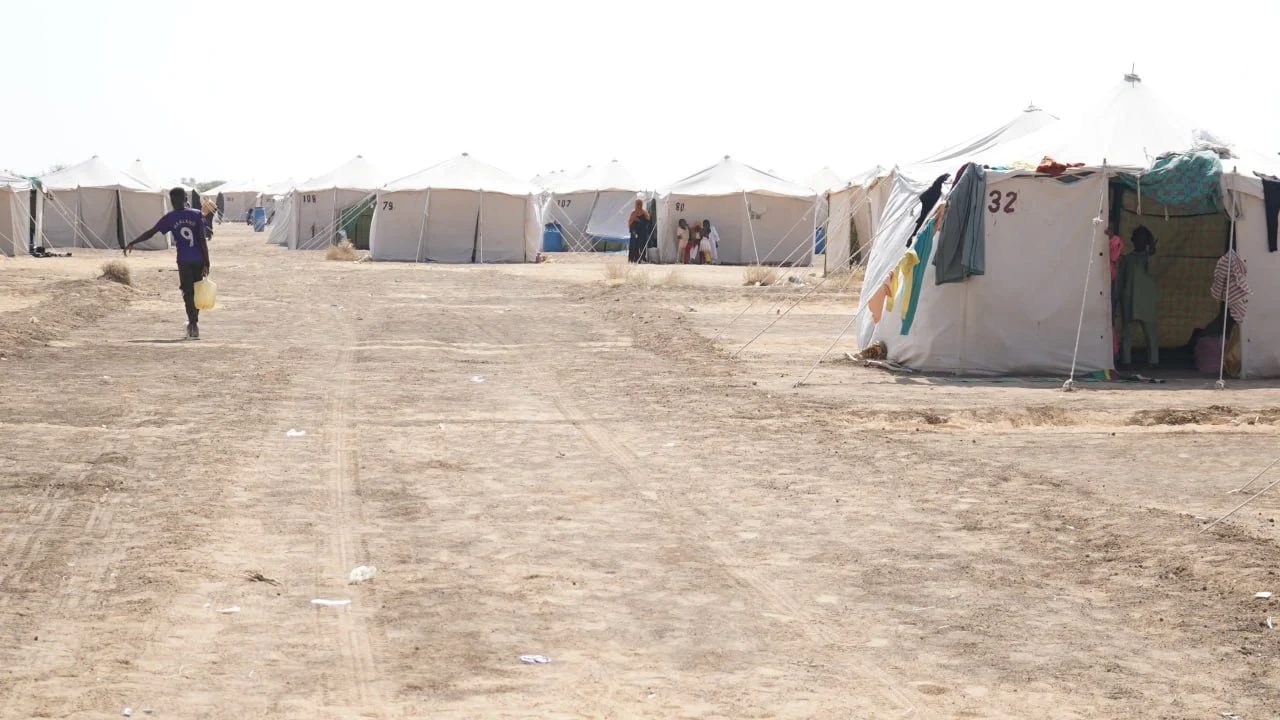
Not every internally displaced person lives in a formal camp.
Many stay with relatives, host families or in towns and communities that absorb large numbers of newcomers.
This can be an important source of safety and dignity.
But it can also place enormous pressure on local services.
A community’s water system may suddenly have to serve thousands more people.
Classrooms become crowded.
Healthcare facilities receive additional patients.
Housing prices can increase.
Jobs become harder to find.
Food demand rises.
Sanitation infrastructure may become inadequate.
This means humanitarian responses need to consider both displaced families and the communities hosting them.
Supporting only one group can leave the wider system under severe strain.
Children Face Particular Risks During Displacement
Children make up the majority of Sudan’s internally displaced population.
IOM’s July data indicates that approximately 55% of IDPs were under 18.
For a child, displacement can affect almost every part of daily life.
Education may stop.
Vaccinations and healthcare can be interrupted.
Nutrition can deteriorate.
Children may become separated from parents or other caregivers.
They may lose safe spaces to play and develop.
They may witness violence or experience repeated fear and uncertainty.
UNICEF reported that more than eight million children remained out of school in Sudan in May 2026, with the most severe educational disruptions concentrated in Darfur and conflict-affected Kordofan. (unicef.org)
Displacement does not explain every school closure in Sudan, but it can make returning to education particularly difficult.
A child may no longer live near their original school.
The school may be damaged.
It may be occupied or closed.
The family may move repeatedly.
Or survival needs may take priority over education.
Women and Girls Can Face Greater Protection Risks
Displacement can also increase protection risks.
UNFPA reported in April 2026 that women and girls in displacement sites in Blue Nile faced increased exposure to harassment and sexual violence because of unsafe living conditions and weakened protection systems. (unfpa.org)
Women and girls may face risks while collecting water or firewood, travelling to services, using inadequate sanitation facilities or living in shelters that provide little privacy or security.
Economic hardship can create additional risks.
UNFPA has warned that displacement, weakened community protection systems and severe economic pressure can contribute to gender-based violence, including sexual violence, exploitation, intimate partner violence and child marriage. (sudan.unfpa.org)
This is why humanitarian protection involves more than physical shelter.
Safety has to be considered in how water points, toilets, healthcare, aid distribution and temporary accommodation are organized.
Displacement Makes Healthcare Harder to Reach
People do not leave medical conditions behind when they flee.
A pregnant woman still needs maternal healthcare.
A person with diabetes still needs medicine.
A child still needs vaccinations.
A cancer patient still needs treatment.
Someone injured during conflict may need emergency care immediately.
But displacement can interrupt all of these services.
A family may arrive somewhere where it does not know the health system.
Nearby clinics may already be overwhelmed.
Medicines may be scarce.
Transport may be expensive.
Sudan’s wider health-system crisis makes this particularly serious.
WHO reported in April 2026 that approximately 21 million people lacked adequate access to health services, while 37% of health facilities across the country were non-functional. (who.int)
Displaced people are therefore often seeking new healthcare at exactly the moment when the system itself has less capacity to provide it.
Water and Sanitation Can Become Immediate Problems
Displacement also creates sudden demand for water.
If a site receives thousands of new residents, existing wells, pipelines or pumps may not provide enough.
Families may need to queue for long periods or depend on less reliable sources.
Sanitation can also deteriorate when the number of people exceeds the number of functioning toilets and waste-management facilities.
These conditions can increase the risk of diarrhoeal and waterborne diseases.
UNICEF’s mid-year 2026 reporting identified displacement, inadequate WASH conditions and limited healthcare access as factors contributing to continuing disease outbreaks in Sudan. (unicef.org)
This is why food, water, sanitation, shelter and healthcare often need to be delivered together in displacement settings.
Returning Home Does Not Automatically Mean Returning to Normal
Almost five million returnees were recorded by IOM in July 2026.
This is an important development.
But “return” should not automatically be interpreted as complete recovery.
Earlier IOM assessments found that 60% of returning households had returned to damaged homes, including houses with collapsed roofs and broken walls or windows. (dtm.iom.int)
The original neighbourhood may also have changed.
Schools may not function.
Health facilities may be damaged.
Markets may have disappeared.
Water or electricity infrastructure may need repairs.
Employment may be unavailable.
Explosive hazards may remain in some areas.
A family can therefore stop being counted as internally displaced while continuing to face serious humanitarian needs.
This is one reason return figures have to be interpreted carefully.
The humanitarian question is not simply:
“Has the family returned?”
It is also:
“Can the family live there safely and sustainably?”
Return Should Be Safe, Voluntary and Sustainable
The UN Guiding Principles on Internal Displacement emphasize the importance of conditions that allow displaced people to return voluntarily, safely and with dignity, or to resettle elsewhere if they choose.
That principle matters in Sudan.
A person should not have to choose between remaining somewhere without basic services and returning to an area that remains unsafe.
Meaningful return requires more than transport.
People may need housing repair, functioning water systems, healthcare, schools, protection, livelihoods and basic infrastructure.
The end of displacement therefore involves rebuilding communities, not only moving populations.
How Amel Foundation’s Work Connects to Displaced Families
Amel Foundation’s documented humanitarian response includes support for people affected by displacement alongside families facing food insecurity, limited healthcare access and urgent daily needs.
Its First Half 2026 Impact Report records programmes across food assistance, community kitchens, WASH and water support, healthcare, clothing distribution, orphan sponsorship, legal support and other community protection activities, delivered through trusted local implementation with Sails of Hope.
These interventions correspond with several of the needs that displacement can create.
A household that has lost regular access to food may need immediate food assistance.
A community receiving displaced families may require additional water capacity.
People who have moved away from their usual healthcare services may need accessible community-based medical support.
Children and vulnerable families may require longer-term care and protection.
But displacement is a complex condition, and no single organization or programme can address every aspect of it.
Sudan’s displacement crisis requires humanitarian assistance alongside protection, functioning public services, safe access, livelihood recovery and conditions that allow people to rebuild their lives.
IDPs Are Not Defined by the Places Where They Sleep
One of the most important things to understand about internal displacement is that “IDP” describes a circumstance, not an identity.
Internally displaced people include farmers, teachers, doctors, business owners, students, children, grandparents and professionals.
Some live in camps.
Others live with relatives.
Some rent accommodation.
Others stay in schools, community buildings, gathering sites or temporary shelters.
Their needs are not identical.
Some may need emergency food today.
Others may need help restarting a business.
A child may need education.
A pregnant woman may need healthcare.
A returning family may need its home repaired.
An older person may need medication.
Humanitarian responses therefore have to look beyond the label and understand the particular circumstances of each community.
What Sudan’s Displacement Numbers Really Tell Us
The July figure of 8.62 million internally displaced people is enormous.
But even that figure cannot capture everything displacement means.
It cannot show how many times a child has had to move.
It cannot show the possessions a family left behind.
It cannot measure the months of education lost.
It cannot describe the fear of travelling through an insecure area.
It cannot tell us whether a returning family finds its home intact.
And it cannot tell us whether someone who has stopped being counted as displaced has actually recovered.
Sudan’s displacement crisis is therefore both a crisis of movement and loss.
Millions of people have been forced away from the places where their lives were built.
Millions are now trying to survive elsewhere.
Others are beginning to return.
At the same time, new fighting continues to uproot families in other parts of the country.
Understanding those movements matters because humanitarian assistance needs to move with them.
Food, water, healthcare, protection and education must reach people where they are now—not only where they were before.
And when families begin to return, recovery needs to follow them home.
Supporting Sudanese Families Affected by Displacement
Amel Foundation supports humanitarian programmes across Sudan addressing food, water, healthcare, protection and other urgent needs affecting vulnerable and displaced communities.

Comments are closed