
Updated: August 2026
For a family forced to flee violence, finding a safer place to stay is only the beginning.
The next questions can be just as urgent.
Where will the family get drinking water? Is that water safe? Is there somewhere to wash hands? Are there enough toilets for the number of people living in the settlement? Can water be stored without becoming contaminated? And if a child develops severe diarrhoea, how far away is the nearest functioning health facility?
These questions are closely connected.
Sudan’s displacement crisis has placed millions of people in temporary shelters, informal gathering sites, camps and already stretched host communities. According to the International Organization for Migration, approximately 8.62 million people remained internally displaced across Sudan at the end of July 2026, with internally displaced people recorded across all 18 states. Around 55% were children under 18.
At the same time, disease outbreaks continue to affect the country.
UNICEF reported in its 2026 mid-year humanitarian update that population displacement, inadequate water and sanitation, and limited access to healthcare continued to contribute to outbreaks including cholera, dengue fever, malaria, measles and hepatitis E.
This is why clean water in an emergency is not simply about relieving thirst.
It is also part of disease prevention.
Why Does Displacement Put Water Systems Under Pressure?
When thousands of people arrive in a community over a short period, the population may grow much faster than local services can expand.
A water system designed for one community may suddenly need to support thousands of displaced families as well.
Pumps operate for longer.
Queues grow.
Water storage becomes more difficult.
Existing toilets and sanitation facilities may become insufficient.
Families may begin collecting water from less protected sources when safer supplies cannot keep up with demand.
This is not theoretical in Sudan.
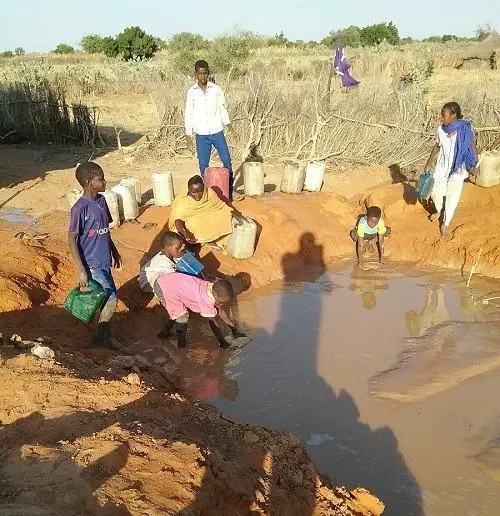
In Tawila, North Darfur, thousands of families displaced from Al Fasher have arrived in already pressured displacement settlements. UNICEF documented families who initially relied on unsafe water, including open wells, with mothers reporting diarrhoea among their children after drinking unsafe water during displacement and after arrival.
New displacement continues to place similar pressure on communities elsewhere.
In Blue Nile State, for example, IOM recorded almost 60,000 new displacements between January and May 2026. Around 72% of those newly displaced people were staying in informal gathering sites, rather than established accommodation.
When displacement occurs at this speed, safe water and sanitation have to expand with the population.
If they do not, health risks can rise quickly.
How Can Unsafe Water Spread Disease?
Water itself is not responsible for every disease seen in displacement settings.
But contaminated drinking water and inadequate sanitation can transmit or increase the risk of several serious infections.
The World Health Organization identifies contaminated water and poor sanitation as being linked to diseases including cholera, diarrhoea, dysentery, typhoid and polio.
The mechanism can be relatively simple.
Human waste may contaminate a water source.
A family then drinks that water, prepares food with it or uses it in the home.
Unsafe water storage can introduce contamination after water has already been collected.
Poor access to toilets can increase contamination of the surrounding environment.
And when water is scarce, families may have too little available for regular handwashing and cleaning.
This creates pathways through which infectious organisms can move from one person to another.
In an overcrowded displacement setting, those pathways can become particularly difficult to control.
Cholera Shows Why WASH Matters
Cholera is one of the clearest examples of the connection between water, sanitation and disease.
WHO describes cholera as an acute diarrhoeal infection caused by consuming food or water contaminated with the bacterium Vibrio cholerae. Access to safe water, sanitation and good hygiene is therefore central to preventing and controlling the disease.
Sudan has experienced repeated cholera outbreaks during the conflict.
Although an earlier outbreak was declared contained in March 2026, UNICEF reported that a new cholera outbreak had emerged in West Kordofan by the end of June, demonstrating the continuing risk of epidemic disease where displacement, poor WASH conditions and limited healthcare overlap.
Cholera can be prevented and treated.
But prevention becomes much harder where large populations do not have dependable safe water, adequate toilets, hygiene supplies and functioning health services.
The disease also demonstrates why humanitarian responses cannot rely on treatment alone.
A cholera treatment centre can save the life of someone who becomes severely ill.
But safe water, sanitation, hygiene, surveillance and vaccination can reduce the opportunities for transmission in the first place.
Diarrhoeal Disease Is Especially Dangerous for Children
Cholera is not the only concern.
Diarrhoeal disease more broadly is particularly dangerous for young children.
WHO identifies diarrhoeal disease as a major cause of illness and death among children under five and notes that a significant proportion can be prevented through safe drinking water, adequate sanitation and hygiene.
Diarrhoea can cause the body to lose water and essential salts.
For a young child, severe dehydration can become dangerous quickly.
The risk can be even greater for a child who is already malnourished or whose immune system has been weakened.
This creates another connection between Sudan’s overlapping humanitarian crises.
Unsafe water can increase the risk of diarrhoeal illness.
Diarrhoea can contribute to nutritional deterioration.
Malnutrition can then make infection more dangerous.
WHO notes that diarrhoea is also a significant contributor to malnutrition among children under five.
Clean water is therefore connected not only to disease prevention but also to child nutrition and survival.
Safe Water Alone Is Not Enough
The term WASH stands for water, sanitation and hygiene.
All three parts matter.
Providing safe drinking water while leaving hundreds of families without adequate toilets still leaves serious public-health risks.
Building toilets without enough water for cleaning and handwashing also limits their effectiveness.
Providing water and sanitation infrastructure without helping communities understand safe storage and hygiene practices can leave other pathways of transmission open.
That is why emergency WASH responses frequently combine several interventions.
They may include water-system repair, chlorination, water quality monitoring, emergency water trucking, sanitation facilities, soap and hygiene supplies, waste management and community hygiene information.
WHO states that WASH measures used to reduce diarrhoeal disease include access to safe drinking water, improved sanitation and handwashing with soap at critical times.
For cholera specifically, WHO also recommends interventions including water quality monitoring, improving WASH services in healthcare facilities, distributing WASH supplies and promoting protective hygiene practices.
The goal is not simply to supply water.
It is to make the environment safer.
What Happens When Water Infrastructure Is Damaged?
Conflict creates another problem: even established water systems can stop working.
A town may have treatment plants, pumps and pipelines, yet attacks on electricity or water infrastructure can interrupt the entire supply.
This has happened repeatedly in Sudan.
In July 2026, UNICEF documented the situation in Al Obeid, where intensified attacks had damaged water infrastructure alongside homes, markets and schools.
Families who had already experienced displacement were then facing water shortages as existing systems came under greater pressure. UNICEF described children and parents waiting in long queues for emergency water trucking after days without reliable water.
This illustrates an important feature of Sudan’s WASH crisis.
Water insecurity is not limited to places that never had infrastructure.
Conflict can transform an established water system into an emergency almost overnight.
When pumps stop operating, families still need water.
They may turn to wells, surface water, private vendors or other sources whose safety and reliability vary.
Emergency water trucking can help bridge the gap, but it is expensive and difficult to sustain indefinitely.
Repairing and protecting functioning water infrastructure therefore matters alongside emergency delivery.
Chlorination Can Play an Important Role During Outbreaks
One important emergency intervention is chlorination.
Chlorine can be used to disinfect drinking water and reduce the risk posed by disease-causing microorganisms when correctly managed.
In Sudan, UNICEF has used chlorination alongside rehabilitation of damaged systems and emergency water provision as part of outbreak response.
Its March 2026 humanitarian report stated that WASH interventions reached more than 650,000 people with safe drinking water during that month, including chlorination and rehabilitation of water systems in overcrowded displacement settings.
By the end of June, UNICEF reported that its WASH interventions had provided 6.6 million people with access to safe water during the first half of 2026, including scaled-up cholera response activities in Kordofan.
These numbers demonstrate the scale at which safe water has become part of the emergency health response.
They also show why WASH cannot be separated from other humanitarian sectors.
Water Quality Has to Be Monitored
Delivering water does not automatically mean delivering safe water.
Water can become contaminated at the original source, during transport or after families collect and store it.
That makes water-quality monitoring another essential part of emergency response.
In displacement sites around Tawila, humanitarian teams have combined emergency water trucking with chlorination and regular water-quality monitoring.
UNICEF reported that water samples were being tested at distribution points while chlorination was maintained across public water stations serving displaced and host communities.
This distinction matters.
The question is not only:
“Is water available?”
It is also:
“Is there enough water, is it safe to drink, and can it remain safe until a family uses it?”
All three affect health.
Sanitation Becomes More Difficult as Camps Become Crowded
Water shortages often receive the greatest attention because people cannot survive without drinking water.
But inadequate sanitation can create equally serious problems.
If thousands of people arrive in a displacement site without enough toilets, open defecation may increase.
Waste can contaminate the surrounding environment.
Rain and flooding can then move contamination into areas where people live or collect water.
Children can be exposed while playing.
The challenge can intensify quickly because a sanitation system must serve the actual population living in the area—not the number of people for whom the site was originally designed.
The same applies to host communities.
A village or town may welcome displaced families, but its existing sanitation and waste-management systems may not be capable of absorbing such rapid population growth.
Supporting host communities is therefore part of protecting displaced people as well.
Women and Children Often Carry the Burden of Water Collection
The consequences of water scarcity are not limited to disease.
When a water point is far away or supply is irregular, someone has to spend time collecting it.
In many communities that responsibility falls heavily on women and girls.
Long journeys to collect water can consume hours that might otherwise be spent at school, earning an income, caring for children or completing other daily activities.
It can also expose people to additional safety risks, depending on the route and security situation.
WHO notes that more accessible water sources can reduce the physical burden and time required for water collection while improving health and productivity.
In displacement settings, proximity therefore matters alongside water quality.
A safe source that families cannot realistically access may still leave them searching for alternatives.
Clean Water Also Supports Healthcare
Hospitals and clinics need water too.
Health workers need clean water for hand hygiene, cleaning equipment, managing waste and maintaining safe patient environments.
Maternity services need it.
Nutrition programmes need it.
Cholera treatment facilities need it.
A health facility without dependable water and sanitation may struggle to provide safe care even if doctors and medicines are available.
This is another reason Sudan’s water and healthcare crises cannot be treated as separate emergencies.
The same damaged infrastructure can affect households, displacement sites, schools and health facilities simultaneously.
Restoring a water system may therefore support more than one sector at once.
WASH and Malnutrition Are Also Connected
Sudan’s nutrition crisis makes effective WASH even more important.
A child who is already malnourished can be especially vulnerable to diarrhoeal disease.
At the same time, repeated diarrhoeal illness can make nutritional recovery more difficult.
WHO notes that diarrhoea contributes to nutritional deficiencies, reduced resistance to infection and impaired growth and development, particularly among vulnerable children.
This is why humanitarian programmes increasingly connect nutrition, healthcare and WASH.
A child may need therapeutic nutrition.
But the family may also need safe water.
The child may need treatment for an infection.
The community may need better sanitation.
Addressing one part while ignoring the others can leave the underlying risks in place.
How Amel Foundation’s WASH Work Fits Into the Response
Water and sanitation are among the areas included in Amel Foundation’s humanitarian programming in Sudan.
Amel Foundation’s First Half 2026 Impact Report records 3,600 WASH beneficiaries across its documented activities during the first six months of the year, alongside food, healthcare, protection and other humanitarian programmes.
The Foundation’s reporting identifies both WASH and water projects within the response delivered through local implementation.
This kind of support should be described carefully.
Providing or improving access to safe water and hygiene addresses important risk factors for disease, but it would be inappropriate to claim that a particular water project “prevented” a precise number of cholera or diarrhoeal cases without epidemiological evidence.
Its value can be stated more accurately:
safe water, sanitation and hygiene help create the conditions communities need to reduce exposure to preventable disease.
That role becomes particularly important for displaced and vulnerable families living in places where existing services have been damaged or overwhelmed.
Emergency Water Delivery and Long-Term Water Systems Serve Different Needs
Water trucking can be lifesaving during an immediate emergency.
If thousands of displaced people arrive somewhere without enough water, trucks can rapidly provide a temporary supply.
But trucking is not the same as a sustainable water system.
Longer-term solutions may include repairing wells, restoring pumps, rehabilitating treatment plants, expanding distribution networks, improving storage or powering water systems more reliably.
Both approaches are necessary at different moments.
Emergency supply keeps people alive while permanent or semi-permanent systems are restored.
More sustainable infrastructure then reduces dependence on repeated emergency deliveries.
Sudan needs both because its displacement crisis is both acute and prolonged.
Some families are newly arriving in emergency gathering sites.
Others have been displaced for months or years.
Their water needs are equally essential, but the most appropriate solution may be different.
Why Disease Prevention Requires More Than One Intervention
Safe water is powerful, but no single intervention can stop Sudan’s disease outbreaks alone.
Cholera control, for example, also requires surveillance, rapid treatment, vaccination where appropriate, health services, sanitation, hygiene communication and safe humanitarian access.
Likewise, malaria prevention involves different interventions because malaria is transmitted by mosquitoes rather than contaminated drinking water.
Dengue also requires vector-control measures.
Measles requires vaccination.
This is why it is important not to describe WASH as a universal solution to every disease affecting Sudan.
Its role is more specific—and still extremely important.
Safe water, sanitation and hygiene can directly reduce several important pathways through which disease spreads and can support the wider health and nutrition response.
Clean Water Is Part of Public Health
The humanitarian importance of water can sometimes be reduced to a simple image: a person who is thirsty receiving a drink.
That matters.
But the real impact of safe water goes much further.
It allows families to prepare food more safely.
It makes handwashing possible.
It supports sanitation.
It helps health facilities operate.
It reduces reliance on unsafe sources.
It can help lower the risk of waterborne and diarrhoeal diseases.
It supports children whose nutrition and immunity are already under pressure.
And when the source is nearby, it can reduce the hours families spend searching for one of life’s most basic necessities.
For displaced communities in Sudan, access to safe water is therefore not a secondary comfort to be addressed after other humanitarian needs.
It is part of the infrastructure of survival.
What Sudan’s Water Crisis Tells Us
Sudan’s displacement crisis shows how quickly a water problem can become a health problem.
Millions of people remain internally displaced while conflict continues to damage infrastructure and place additional pressure on communities receiving displaced families.
At the same time, outbreaks continue to demonstrate what happens when population movement, weak sanitation, interrupted healthcare and unreliable water supplies overlap.
The response therefore has to operate on several levels.
Families need enough water today.
That water needs to be safe.
Communities need adequate sanitation.
People need the ability and supplies to practise basic hygiene.
Damaged systems need to be repaired.
Water quality needs to be monitored.
And longer-term infrastructure needs to become more resilient to continued pressure.
Because in a humanitarian emergency, clean water does more than satisfy thirst.
It helps protect health.
Supporting Water and Humanitarian Assistance in Sudan
Amel Foundation supports humanitarian programmes in Sudan that include water and WASH assistance alongside food, healthcare, protection and other essential needs.
Learn more about Amel Foundation’s work at AmelFoundation.org.

Comments are closed