
Updated: August 2026
Sudan remains in one of the most severe food and nutrition crises in the world.
The latest nationwide analysis from the Integrated Food Security Phase Classification (IPC) found that nearly 19.5 million people around 41% of Sudan’s population were facing Crisis-level or worse acute food insecurity between February and May 2026. More than 5 million were in Emergency conditions, while approximately 135,000 people were experiencing Catastrophic levels of food insecurity.
Food insecurity does not simply mean that food is expensive or that a household occasionally misses a meal. At the more severe IPC levels, families may face large gaps in what they are able to eat, sell essential assets to survive, lose their livelihoods, or reach conditions where starvation, severe malnutrition and increased risk of death become real threats.
And as Sudan moved into the June–September 2026 lean season, the available evidence pointed to further deterioration in some of the country’s most vulnerable areas.
How Severe Is Sudan’s Food Crisis in 2026?
The IPC’s May 2026 analysis provides the latest nationwide picture of acute food insecurity in Sudan.
For the February–May 2026 period:
- Nearly 19.5 million people were experiencing IPC Phase 3 or above.
- More than 14 million people were in IPC Phase 3, or Crisis.
- More than 5 million people were in IPC Phase 4, or Emergency.
- Approximately 135,000 people were in IPC Phase 5, or Catastrophe.
This means roughly two out of every five people in Sudan were facing levels of acute food insecurity serious enough to threaten their health, livelihoods, or survival.
The situation becomes even more concerning when food insecurity is considered alongside displacement, malnutrition, weakened health services and restrictions on humanitarian access.
UNICEF reported that 33.7 million people in Sudan required humanitarian assistance in 2026, including 17.3 million children. More than 9.1 million people were internally displaced according to its mid-year reporting.
These crises do not exist separately. Displacement can remove families from their farms, jobs, markets and social support networks. A lack of clean water can increase disease. Disease can worsen malnutrition. Malnutrition can make children more vulnerable to illness.
Sudan’s food crisis is therefore not only a question of food availability. It is the result of several systems failing at the same time.
What Do the IPC Numbers Actually Mean?
The IPC is an internationally used system for classifying the severity of acute food insecurity.
Its Acute Food Insecurity scale has five phases:
IPC Phase 1 Minimal: Households can generally meet their essential food and non-food needs without using unusual or unsustainable coping strategies.
IPC Phase 2 Stressed: Families can still maintain minimally adequate food consumption but struggle to afford other essential needs.
IPC Phase 3 Crisis: Households begin experiencing food gaps or can meet minimum food requirements only by using harmful coping strategies, such as depleting essential livelihood assets.
IPC Phase 4 Emergency: Families face large food gaps, very high levels of acute malnutrition or major losses of livelihood assets.
IPC Phase 5 Catastrophe/Famine: At household level, Catastrophe describes an extreme lack of food and basic needs even after families have exhausted coping strategies. At area level, Famine requires additional thresholds involving widespread food deprivation, acute malnutrition and mortality.
A household can be classified in IPC Phase 5 Catastrophe without the wider area being classified as Famine. Famine is an area-level classification and requires several thresholds to be met simultaneously.
The May 2026 IPC analysis did not classify any area of Sudan as currently being in Famine, although households in several areas were already experiencing Catastrophic food insecurity.
At the same time, the IPC identified a risk of Famine in 14 areas across North Darfur, South Darfur and South Kordofan if conflict, access restrictions and other conditions worsen.
What Does the June–September 2026 Outlook Tell Us?
The February–May IPC analysis covered Sudan nationwide: 195 localities and internally displaced person settlements.
For the June–September lean season, however, sufficient data was available for only 56 localities and IDP settlements, representing approximately 8.3 million people and including many of the populations already considered most food insecure.
Within those assessed areas, around 5.57 million people were projected to face IPC Phase 3 or worse, including approximately 2.25 million in Emergency and almost 200,000 in Catastrophe.
Those numbers should not be treated as a new nationwide estimate.
They cover only part of Sudan.
That limitation is important because conflict and humanitarian access restrictions make it difficult to collect reliable data in some of the areas where conditions may be most severe. The IPC itself warns against directly comparing the nationwide February–May numbers with the geographically limited June–September projection.
What the projection does show is that conditions in several already vulnerable areas were expected to become even more dangerous during the lean season.
FAO and WFP subsequently identified Sudan among the world’s food-security “hotspots of highest concern” for June–November 2026. Their outlook warned that the number of people experiencing Catastrophic food insecurity in the areas assessed could rise to around 200,000 during June–September.
Why Is Sudan Facing Such Severe Food Insecurity?
There is no single cause.
Conflict continues to disrupt how people produce and access food
Sudan’s conflict has displaced millions of people and disrupted agricultural production, trade routes, markets and basic services.
Farmers may be unable to safely reach their land. Agricultural inputs can become more expensive or unavailable. Transport becomes more difficult. Markets may operate irregularly, while families who have lost their income become less able to afford what food remains available.
FAO estimated Sudan’s 2025 cereal production at around 5.2 million tonnes 22% lower than the previous year and 19% below the five-year average. The agency linked the decline to conflict, rising agricultural input costs and disruptions to livelihoods and markets.
For a country in which millions of households depend directly or indirectly on agriculture, damage to the food-production system can continue affecting families long after a particular harvest.
Displacement separates families from livelihoods
Displacement is another major driver.
More than 9 million people remained internally displaced in UNICEF’s 2026 reporting.
When people are forced to leave their homes, they may also lose land, livestock, businesses, tools, savings and regular access to local markets.
The receiving communities then face additional pressure as populations increase while water, food, healthcare and other services remain limited.
In July 2026, WFP warned that El Obeid in North Kordofan was becoming a major centre of displacement and hunger. Hundreds of thousands of displaced people were being hosted in and around the city, while food, fuel and water supplies were under increasing pressure.
Humanitarian access remains difficult
Humanitarian assistance can reduce hunger, but only when aid can safely and consistently reach the people who need it.
Conflict, insecurity and restrictions on movement continue to interfere with that access.
WFP reported in July that active conflict had prevented it from delivering planned lifesaving assistance to approximately 200,000 people during June alone.
This means food insecurity can worsen even when supplies and humanitarian programmes exist, simply because reaching a community becomes too dangerous or logistically impossible.
Food Insecurity Is More Than Hunger
The phrase “food insecurity” can sound abstract.
For a household, however, it can involve a series of increasingly difficult choices.
A family may begin by buying cheaper food or reducing dietary variety. Adults may reduce their own portions so children can eat. Families may begin skipping meals, borrowing money or selling belongings.
As conditions become more severe, they may sell tools, livestock or other assets that would normally help them earn an income in the future.
This is one reason severe food insecurity can become self-reinforcing.
The strategy that allows a family to survive today may leave it less able to recover tomorrow.
Food insecurity also interacts closely with health and nutrition. Children are particularly vulnerable when insufficient food combines with disease, unsafe water and reduced access to healthcare.
The IPC estimates that around 825,000 children under five are expected to suffer from severe acute malnutrition in Sudan during 2026, an increase from 2025 and substantially above pre-conflict levels.
By the end of June, UNICEF reported that it and its partners had screened 5.3 million children for acute malnutrition and treated 174,700 children suffering from severe acute malnutrition.
Malnutrition is therefore connected to Sudan’s food crisis, but the two terms are not interchangeable. Food insecurity describes problems in obtaining adequate food. Malnutrition refers to nutritional outcomes influenced not only by food intake but also by disease, sanitation, healthcare and other conditions.
Why Local Food Assistance Still Matters
The scale of Sudan’s crisis requires large international humanitarian operations, functioning markets, agricultural recovery and sustained access.
But local response also plays an important role.
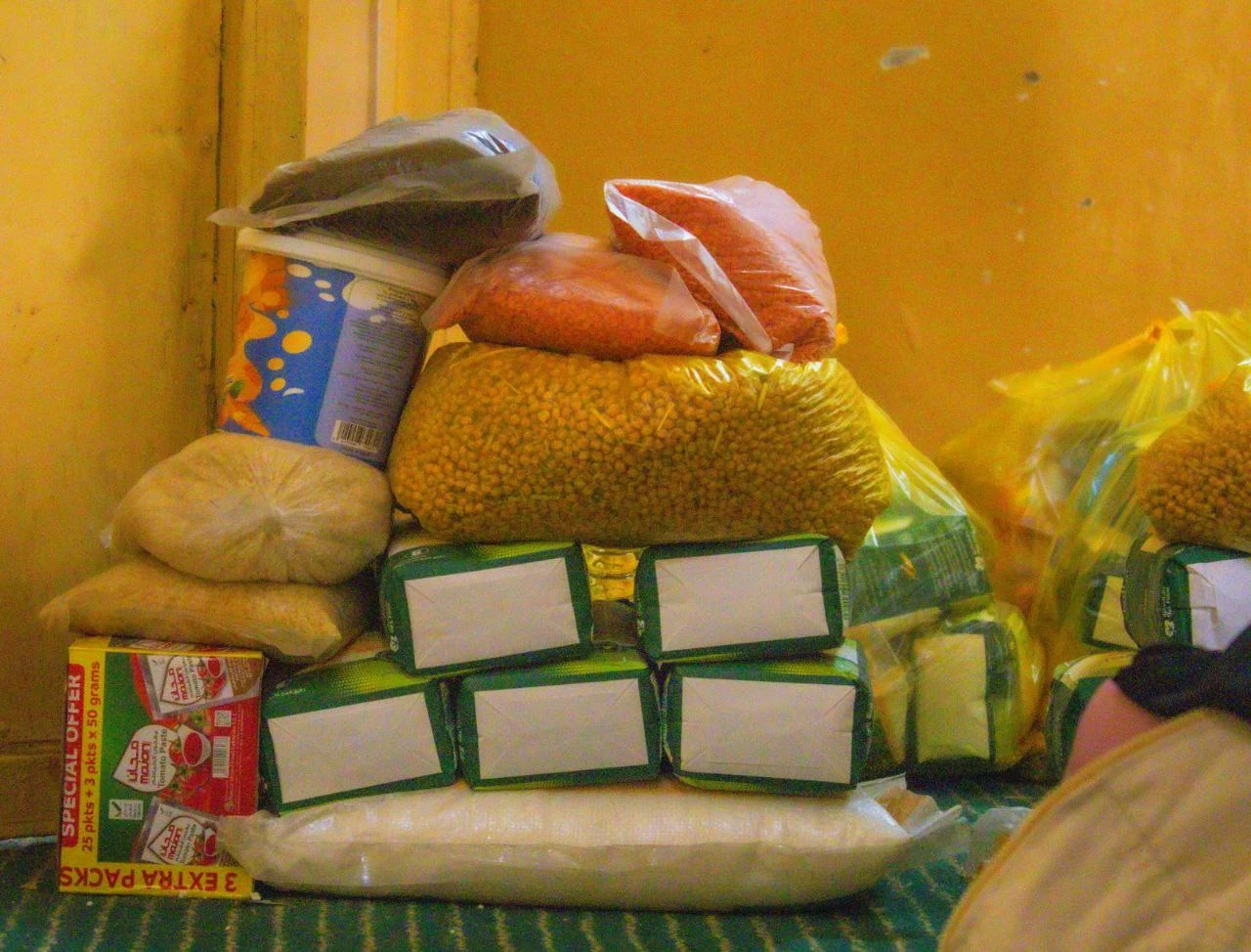
Community kitchens, food baskets and locally organized distributions can provide immediate support to families who have lost reliable ways to obtain or prepare food.
They can be particularly relevant for displaced households without consistent access to cooking facilities.
Local organizations can also draw on community knowledge to identify needs, work with existing networks and adapt their response to changing conditions.
This does not replace the need for a much larger humanitarian response. It is one part of it.
How Amel Foundation Supports Food Security in Sudan
Food assistance has been one of Amel Foundation’s major areas of humanitarian work in 2026.
According to Amel Foundation’s First Half 2026 Impact Report, its Ramadan response distributed 2,355 food baskets reaching 14,130 beneficiaries. Its community-kitchen work provided 87,000 meals, while the Ramadan campaign recorded more than 23,000 people supported overall across food-basket and kitchen activities.
Amel’s recorded Ramadan food response reached communities across White Nile, Al Jazirah, Northern State, Sennar, Khartoum, Nile River and Omdurman, with implementation carried out through local teams and Amel’s partnership with Sails of Hope.
The Foundation’s broader first-half reporting also recorded 7,106 beneficiaries through its 2026 Qurbani programme.
These programmes represent one part of a much wider food-security response needed across Sudan. Their role is practical: helping families access food during periods in which displacement, conflict and loss of livelihoods have made meeting even basic daily needs increasingly difficult.
What the Latest Data Tells Us
The most important lesson from Sudan’s 2026 IPC data is not simply that millions of people are hungry.
It is that food insecurity is being driven by a combination of conflict, displacement, damaged livelihoods, weakened agricultural production, constrained humanitarian access and disruption to essential services.
The latest nationwide IPC assessment found almost 19.5 million people facing Crisis-level or worse acute food insecurity through May.
The more limited June–September projection then indicated worsening conditions among many of the high-risk communities for which sufficient data was available.
At the same time, the absence of complete nationwide projection data should not be mistaken for an absence of need.
In some parts of Sudan, the same insecurity that makes people difficult to assist also makes their situation difficult to measure.
Preventing further deterioration therefore depends not only on food assistance, but also on safe humanitarian access, protection of civilians, functioning healthcare and WASH services, support for agriculture and livelihoods, and sustained action in communities facing the greatest risks.
For families living through Sudan’s crisis, the numbers are not statistics alone.
They describe whether a household can find its next meal, whether a child can remain healthy, and whether a family can preserve enough of its livelihood to begin rebuilding when conditions allow.
Supporting Food Assistance in Sudan
Amel Foundation continues to support food assistance and community-based humanitarian programmes for vulnerable families in Sudan through trusted local implementation.
Learn more about Amel Foundation’s work or support its humanitarian response at AmelFoundation.org.

Comments are closed