
 Are you ready to help?
The Crisis That Demands the World’s Attention
In the heart of Africa, Sudan is facing one of the world’s most devastating humanitarian emergencies. Ongoing conflict has fractured the nation, leaving over 13.5 million people in urgent need of humanitarian aid. More than 5.4 million people have been displaced, including entire families forced from their homes by violence, hunger, or climate disasters. Camps are overcrowded. Clean water is scarce. Basic healthcare is collapsing under pressure.
Despite the chaos, there is still hope, a fragile yet fierce kind of hope that lives in the resilience of the Sudanese people. Now, more than ever, raising hope is not just a phrase. It’s a mission. A call to action. A responsibility we share.
The Growing Humanitarian Needs
Every day, the crisis grows deeper. Millions go to sleep hungry. According to the International Rescue Committee, severe food insecurity is rising rapidly, especially among displaced families. Crops have failed. Livelihoods have vanished. Inflation has pushed basic food out of reach. In some regions, malnutrition among children has surged by 300%.
Sudan’s fragile healthcare system is under intense pressure. With cholera outbreaks and other communicable diseases spreading, and no stable water or sanitation systems, communities are facing a dangerous public health collapse. WHO reports show repeated waves of preventable illness, especially in camps for the internally displaced.
But food, water, and healthcare are not abstract needs. They are the difference between life and death. That’s why AMEL Foundation’s emergency relief programs are focused on delivering these essentials with urgency and care.
Displacement: More Than Movement, It’s Loss
Displacement is not just a change in location. It is the loss of home, history, and identity. As of today, more than 2.5 million Sudanese are displaced inside the country, with another 1.1 million fleeing across borders. Many have been forced to move multiple times, each time deeper into uncertainty.
The displaced face severe protection risks from exploitation to illness, from exposure to harsh weather to lack of clean water. Families are often separated. Children miss years of education. People with disabilities or chronic illnesses are especially vulnerable. In overcrowded camps and abandoned schools-turned-shelters, basic human dignity hangs by a thread.
Yet even in these desperate conditions, local communities show remarkable strength. Sudanese families share what little they have. Volunteers risk their safety to reach those in need. This is community resilience, and it is at the heart of what the AMEL Foundation supports through its food security and healthcare projects.
Hunger Is Not Just a Crisis — It’s an Emergency
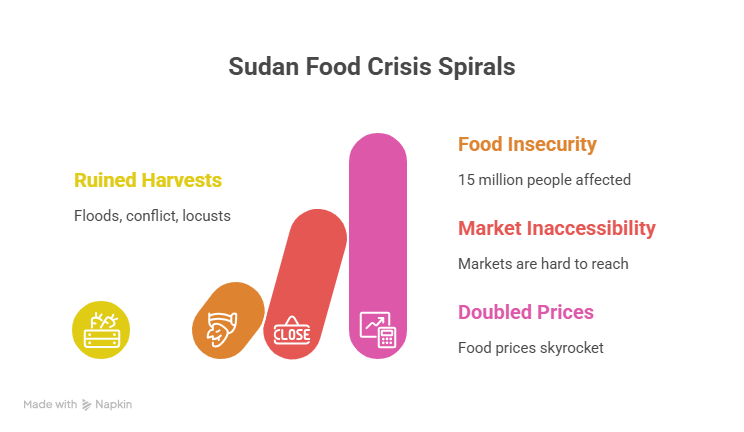
The food crisis in Sudan is spiraling. Over 15 million people are estimated to be facing food insecurity. Harvests have been ruined by floods, conflict, and locust swarms. Markets are inaccessible, and food prices have more than doubled in many areas.
Mothers skip meals to feed their children. Children show signs of wasting and stunting. Entire communities depend on emergency food distributions to survive — and yet, those distributions are becoming harder to deliver as roads are damaged, supply chains blocked, and humanitarian corridors shut down by conflict.
The AMEL Foundation has launched targeted food assistance programs to serve vulnerable populations. But sustaining these efforts requires consistent donor support. Every meal delivered is a message: You are not forgotten.
Water, Health, and the Shadow of Cholera
Clean water has become a rare commodity in many parts of Sudan. The collapse of municipal infrastructure and contamination of wells have left millions dependent on unsafe water sources. This has led to a rise in waterborne diseases — most alarmingly, recurring cholera outbreaks in camps and towns.
In recent months, OCHA reports have confirmed dozens of new outbreaks, straining already minimal health resources. Clinics run out of oral rehydration salts. Staff are overworked or displaced themselves. Prevention becomes almost impossible in overcrowded settings with poor sanitation.
Through its water access initiatives, the AMEL Foundation is working to rehabilitate wells and distribute purification kits. Clean water saves lives especially in emergency contexts where every drop counts.
The Barriers to Reaching Those Most in Need
Despite the massive needs, humanitarian access remains dangerously limited. Active conflict zones are often closed off, and aid convoys risk looting or attack. Roads are blocked or washed out. Fuel shortages delay trucks. In some regions, emergency relief cannot reach communities for weeks at a time.
Even where aid is possible, underfunding is a constant obstacle. Donor fatigue and competing global crises have led to critical funding shortfalls for Sudan. According to UN OCHA, less than 40% of the required humanitarian funding for 2025 has been received so far.
The AMEL Foundation, alongside local partners, continues to fill these gaps through agile, community-based programs that deliver food, medicine, and shelter directly to the people. But to expand this impact, more support is urgently needed.
Answering the Questions That Matter
Can donors really make a difference now?
Absolutely. Every donation translates into practical support — food for a hungry family, medicine for a sick child, dignity for a displaced elder. Donor dollars are the backbone of emergency response and long-term recovery.
Which aid efforts have the most immediate impact?
Food, water, shelter, and healthcare are the frontline needs. Investing in local aid delivery mechanisms ensures speed, accountability, and cultural sensitivity.
What threats still lie ahead?
Without urgent action, famine is likely to spread. Disease outbreaks could become uncontrollable. Another harsh winter could push vulnerable families past the breaking point. And the longer children are out of school, the deeper the wound to Sudan’s future.
How does aid reach those who need it most?
The AMEL Foundation works with trusted local networks and partners already embedded in crisis zones. With a deep understanding of community dynamics, we ensure that aid reaches the most affected — efficiently and ethically.
Stories That Show Resilience
In Kassala, a midwife named Noura delivers babies in a tent using borrowed tools and candles for light. In El Geneina, a youth collective cleans debris from damaged streets to make it safer for families returning to their neighborhoods. These acts may seem small, but they embody what it means to be Sudanese right now: to survive, adapt, and care for one another even in the face of overwhelming odds.
These stories are not exceptions. They are reminders that even in the darkest times, there is courage. There is strength. There is hope.
Why Hope Needs Action
Hope without action is just a wish. But hope backed by empathy, support, and resources becomes power. That is the mission of the AMEL Foundation — not just to tell stories of suffering, but to respond to them with purpose.
Through our donation platform, individuals and institutions can help fund emergency food packages, water purification systems, maternal care kits, and mobile health units. These aren’t abstract contributions. They are life-saving interventions, delivered by trained teams with proven track records.
Raising hope in Sudan means recognizing that every life matters, every family counts, and every contribution makes a difference. Whether you are a policymaker, diaspora community member, or a concerned global citizen, this is your moment to stand with Sudan.
Conclusion: Rebuilding From the Rubble
The crisis in Sudan may seem overwhelming and it is. But despair is not the answer. The Sudanese people are not giving up, and neither should we. Through war, hunger, and displacement, they continue to show the world what resilience looks like.
By standing together through donations, awareness, and policy pressure we can turn suffering into healing, scarcity into stability, and fear into a future. We can be the reason a child eats tonight. We can be the reason a mother survives childbirth. We can be part of raising hope.Join the AMEL Foundation in this work. Learn more about our history and how you can help build a future where no one is left behind. Hope is not only possible — it is already rising.

Comments are closed