
Updated: September 2026
Humanitarian crises are often divided into categories.
Food security.
Water.
Healthcare.
Protection.
Children.
Education.
But families do not experience emergencies in separate categories.
A family without enough food may also lack safe water. A displaced child may need healthcare, education and protection at the same time. A household that receives a food basket may still struggle to reach a clinic. A functioning water source can reduce one health risk while a family continues facing unemployment, displacement or insecurity.
Amel Foundation’s work during the first half of 2026 provides a useful example of how interconnected humanitarian needs can be.
Across its recorded activities, Amel supported food distributions, community kitchens, water and sanitation interventions, healthcare activities, orphan sponsorship, legal support and seasonal programmes such as Qurbani.
Taken individually, each programme addresses a specific need.
Taken together, they show something broader:
Humanitarian recovery rarely depends on one intervention alone.
Sudan’s Humanitarian Needs Remain Deeply Connected
Sudan entered 2026 with one of the world’s largest humanitarian emergencies.
UNICEF estimated that 33.7 million people required humanitarian assistance in 2026, including 17.3 million children. The crisis combined displacement, acute food insecurity, disease outbreaks and disruption to essential services.
The food crisis alone affected an enormous share of the population.
IPC estimated that nearly 19.5 million people around 41 percent of Sudan’s population were experiencing Crisis-level or worse acute food insecurity between February and May 2026.
At the same time, Sudan’s health system remained severely weakened. WHO reported in April that 37 percent of health facilities across the country’s 18 states were non-functional.
These are usually presented as separate statistics.
In everyday life, however, they interact.
A child affected by malnutrition becomes more vulnerable when healthcare is difficult to reach.
A family living with unsafe water may face greater disease risk.
A displaced household may lose both its home and its income.
This is why integrated humanitarian assistance matters.
What Did Amel Foundation Record During the First Half of 2026?
Amel Foundation’s first-half reporting documents humanitarian work across several programme areas.
Across recorded 2026 activities, the organization reported more than 61,637 in beneficiary reach.
That number should be interpreted carefully.
A person may receive more than one type of assistance, and different programmes measure outputs in different ways. Unless beneficiary records have been fully de-duplicated across every programme, the total should not automatically be interpreted as 61,637 completely unique individuals.
That distinction is important in responsible humanitarian reporting.
The purpose of impact data is not simply to produce the largest possible number.
It is to understand what was delivered, who was reached and what needs the activities were designed to address.
Amel’s first-half records included 87,000 meals served, 2,355 food baskets distributed, support reaching 7,106 people through Qurbani activities, 3,600 beneficiaries through WASH activities, 1,082 beneficiaries through health activities, 11,883 beneficiaries through legal support and 200 beneficiaries through orphan sponsorship.
These figures describe very different forms of assistance.
And that is exactly what makes them useful for understanding Sudan’s humanitarian needs.
Food Security Is About More Than One Meal
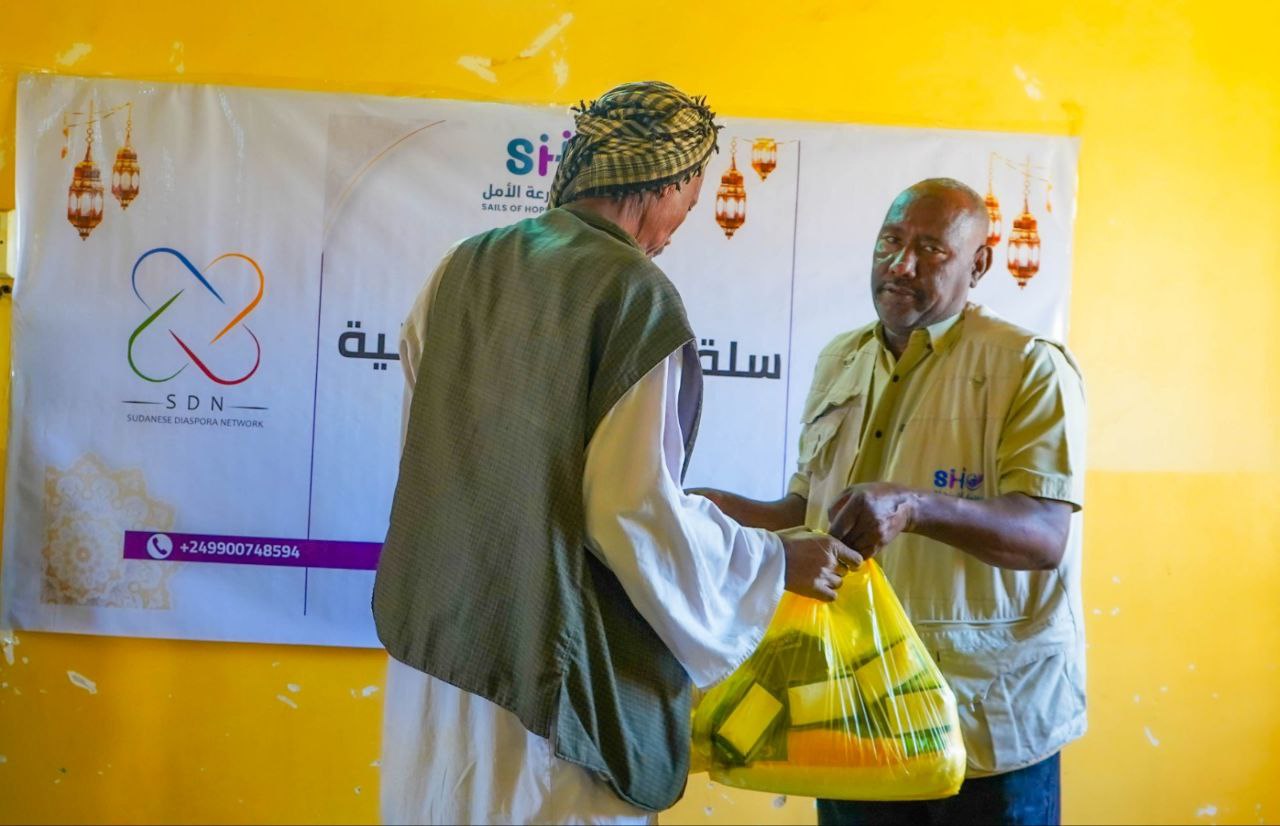
Food assistance represented a significant part of Amel’s first-half response.
Community kitchens and related feeding activities recorded 87,000 meals.
Food-basket distributions added another form of support, with 2,355 food baskets recorded during the period.
These two interventions may appear similar because both address hunger.
But they solve different problems.
A community kitchen can provide immediate cooked food to people who may not have the ingredients, equipment, fuel or stable shelter needed to prepare meals themselves.
A food basket gives a household supplies that can be used over a longer period when cooking facilities are available.
The right form of assistance therefore depends on the circumstances.
A newly displaced family may need ready-to-eat or cooked meals immediately.
Another household may be better served by receiving staple foods that allow the family to prepare meals independently.
This illustrates a wider lesson in humanitarian work:
Providing food is not one single activity.
Food security programmes have to consider how people are living, whether markets are functioning, whether cooking is possible and how long assistance needs to last.
Seasonal Assistance Can Respond to Both Nutrition and Dignity
Amel’s Qurbani activities reached 7,106 recorded beneficiaries during the first half of 2026.
Qurbani is a faith-based programme, but in a severe food-security crisis it also becomes part of the humanitarian nutrition response.
For families unable to afford meat regularly, seasonal distributions can provide access to protein at a culturally and religiously significant time.
But the importance is not purely nutritional.
Humanitarian assistance also affects dignity and participation in community life.
Families experiencing poverty or displacement should not be understood only through what they lack.
Religious and cultural moments remain important.
Programmes such as Qurbani can therefore combine material assistance with the ability to participate in an important shared occasion.
This demonstrates why humanitarian response is not only about keeping people physically alive.
It is also about helping people maintain dignity and community connection during crisis.
Water Support Is Also a Health Intervention
Amel’s first-half reporting recorded 3,600 beneficiaries through water, sanitation and hygiene activities.
At first glance, WASH appears to be a separate programme area from healthcare.
In practice, the two are closely connected.
Safe water affects drinking, cooking, hygiene and sanitation.
When water sources become contaminated, the risk of diarrhoeal and other water-related illnesses increases.
When families have insufficient water, maintaining hygiene becomes more difficult.
When health facilities lack adequate water, infection prevention also becomes harder.
Sudan’s wider humanitarian response demonstrates this connection at scale. During the first half of 2026, UNICEF reported providing 6.6 million people with access to safe water, alongside health, nutrition and cholera-response activities.
The lesson is straightforward.
A water intervention should not be viewed only as an infrastructure project.
It can also be part of disease prevention, household protection and community recovery.
Healthcare Support Cannot Be Separated From Living Conditions
Amel recorded 1,082 health beneficiaries during the first half of 2026, including activities such as free medical days and community healthcare support.
The number is smaller than some of the organization’s food or legal-support figures.
That does not make the programme less significant.
Different humanitarian interventions operate at different scales and costs.
Serving one meal and delivering one medical consultation are not comparable units.
A healthcare activity may require trained clinicians, medicines, diagnostic tools, transport, referral arrangements and follow-up.
That is why responsible impact reporting should avoid treating every beneficiary figure as if it represented an identical service.
Healthcare outcomes are also influenced by conditions outside the clinic.
A patient treated for illness may return to a household without safe water.
A malnourished child may require both medical treatment and reliable food.
A pregnant woman may need healthcare but also safe transport to reach a facility.
Amel’s healthcare work therefore sits within a wider humanitarian system rather than functioning independently from food and WASH programmes.
Children Need More Than Emergency Relief
Amel’s first-half reporting also records 200 beneficiaries through orphan sponsorship.
The number may be modest compared with large food distributions, but child sponsorship represents a different type of humanitarian commitment.
A meal addresses an immediate need.
Supporting a vulnerable child may require continuity.
Children affected by conflict can need food, healthcare, clothing, education, protection and stable caregiving over extended periods.
This is particularly important in Sudan, where children make up an enormous share of the population affected by the humanitarian crisis.
UNICEF estimated that 17.3 million children required humanitarian assistance in 2026.
The first half of the year also showed how children’s needs overlap across sectors. UNICEF and partners treated children for severe acute malnutrition, provided primary healthcare, expanded safe-water access and supported education and psychosocial services.
The same principle applies at a smaller organizational level.
Child welfare cannot be reduced to one programme.
A child may need assistance from several systems before genuine stability becomes possible.
Legal Support Is a Humanitarian Need Too
One of the most notable figures in Amel’s first-half reporting is 11,883 beneficiaries through legal-support activities.
Legal assistance receives far less public attention than food or medical aid.
Yet humanitarian crises create many problems that require documentation, rights awareness or legal support.
Displacement can separate people from identity papers.
Families may face disputes involving housing or property.
People may need help understanding legal processes.
Women and vulnerable groups may require protection-related assistance.
Documents can be lost when people flee suddenly.
Legal identity can also affect access to education, healthcare and other services.
This shows why humanitarian response cannot be understood only through physical goods.
A person may have food and water but still be unable to resolve a legal issue affecting their security or access to services.
Protection and legal-support programmes address a different dimension of vulnerability.
Their inclusion in Amel’s first-half activities broadens the picture of what humanitarian need actually looks like.
The Data Also Shows Why We Should Not Compare Programmes Only by Size
Impact reports naturally draw attention to numbers.
But the largest number is not automatically the most important programme.
Eighty-seven thousand meals sounds much larger than 200 orphan-sponsorship beneficiaries.
But they measure completely different things.
A meal is an individual unit of assistance.
A sponsored child may receive support repeatedly over an extended period.
Similarly, one legal-support beneficiary and one health beneficiary may require very different levels of time and resources.
The most responsible way to read humanitarian impact data is therefore not to ask:
“Which programme has the biggest number?”
A better question is:
“What problem was this programme trying to solve, and what does its output tell us about the needs communities were facing?”
This approach prevents impact reporting from becoming a competition for impressive statistics.
Humanitarian Needs Often Appear in Chains
The first-half programmes also demonstrate how one humanitarian problem can trigger another.
Consider a displaced household.
Conflict forces the family to leave home.
Loss of home may mean loss of employment.
Loss of income makes food harder to afford.
Poor nutrition increases vulnerability to illness.
Unsafe water increases disease risk.
Illness creates a need for healthcare.
Children may leave school.
Documents may be lost during displacement.
One original shock has now created needs across food, water, health, education and protection.
This is why humanitarian programmes need coordination.
Providing one service can be life-saving.
But understanding the household’s wider situation helps identify what comes next.
Emergency Relief and Recovery Have Different Jobs
Amel’s first-half activities also span both immediate relief and forms of longer-term support.
Community kitchens respond to immediate hunger.
Healthcare interventions address urgent medical needs.
WASH activities support essential services and disease prevention.
Orphan sponsorship can involve ongoing child welfare.
Training, development and livelihood-oriented programmes can support longer-term resilience.
These activities should not be confused.
Emergency relief exists because people have urgent needs now.
Longer-term recovery tries to reduce vulnerability in the future.
One does not replace the other.
A family that is hungry today cannot wait for a livelihood programme to produce income six months later.
But providing food indefinitely without addressing livelihoods also does not create sustainable recovery.
Strong humanitarian work often has to operate in the space between those two realities.
Local Implementation Matters
Many of Amel’s Sudan activities are carried out through local implementation arrangements and community networks.
This matters because humanitarian delivery depends heavily on information that exists at community level.
Which families have recently arrived?
Which neighbourhoods have lost water?
Where is a community kitchen most needed?
Which road remains accessible?
Who is particularly vulnerable?
Local organizations and community responders often understand these details before larger institutions do.
That does not mean local groups can solve a national humanitarian crisis alone.
Sudan requires substantial international funding, logistics and technical support.
But local knowledge helps ensure that resources can be adapted to actual circumstances.
Amel’s model illustrates how a U.S.-registered nonprofit can support humanitarian work while relying on people and organizations closer to affected communities for implementation and local understanding.
Measurement Should Improve Alongside Programmes
The first-half numbers also point to an important next step for humanitarian reporting.
As programmes grow, measurement should become more precise.
Organizations should distinguish clearly between:
outputs, such as meals served or food baskets distributed;
people reached, meaning the number of beneficiaries who received a particular service; and
unique individuals reached across the organization, which requires de-duplicating people who received more than one service.
These are not the same.
For example, 87,000 meals should never simply be added to 3,600 WASH beneficiaries to produce a larger “people reached” figure.
Doing so would mix units.
Similarly, a person who received food assistance and later healthcare should not automatically be counted as two unique people when reporting total organizational reach.
Clear measurement strengthens credibility.
It also makes future impact reports more useful because Amel can compare not only how much activity occurred, but how programme reach and needs change over time.
What Does the First Half of 2026 Tell Us?
The most important lesson from Amel Foundation’s first-half work is not one headline number.
It is the range of needs the organization encountered.
87,000 meals point to continued food insecurity.
2,355 food baskets show the need for household-level food support.
7,106 Qurbani beneficiaries demonstrate the role seasonal assistance can play during severe hunger.
3,600 WASH beneficiaries reflect continuing water and sanitation needs.
1,082 health beneficiaries show demand for accessible healthcare.
11,883 legal-support beneficiaries demonstrate that humanitarian protection extends beyond material aid.
200 orphan-sponsorship beneficiaries represent children requiring continued care and stability.
Together, they describe a crisis where no single programme is enough.
What Should Humanitarian Impact Look Like Going Forward?
Humanitarian organizations are often judged by how much assistance they distribute.
That matters.
But strong impact should eventually be understood through more than volume.
Did families gain more reliable access to food?
Did a water intervention remain functional?
Did patients receive appropriate follow-up?
Were vulnerable children able to remain in supportive environments?
Did legal assistance resolve barriers that people were facing?
Did programmes strengthen local capacity?
These questions move humanitarian reporting from activity toward outcome.
That transition is important for Amel as its work develops.
The first-half figures establish what was delivered.
Future reporting can increasingly show what changed because of that assistance.
One Crisis, Many Connected Needs
Sudan’s humanitarian emergency is too complex to be explained through one statistic.
It is simultaneously a hunger crisis, a health crisis, a displacement crisis, a water crisis, a protection crisis and a crisis affecting children’s futures.
The same is true at household level.
People rarely experience one problem at a time.
Amel Foundation’s first-half 2026 work reflects that reality.
Its programmes did not solve Sudan’s humanitarian crisis.
No individual organization could.
But the mix of food, water, healthcare, child support, legal assistance and seasonal relief shows why humanitarian response needs to be multidimensional.
The lesson is not that every organization must do everything.
It is that every intervention should understand what surrounds it.
Food connects to health.
Water connects to health.
Protection connects to displacement.
Child welfare connects to food, education and family stability.
Recovery connects to all of them.
Humanitarian statistics become most useful when they help us see those relationships.
And that may be the most important thing Amel Foundation’s first-half 2026 work tells us:
People do not experience humanitarian crises in programme categories.
They experience them as lives disrupted in many ways at once.
Effective humanitarian response must be able to see the whole picture.
Learn More About Amel Foundation
Amel Foundation is a U.S.-registered nonprofit supporting humanitarian assistance and community resilience in Sudan through programmes including food security, water, healthcare, child support and other forms of relief.
Learn more about Amel Foundation’s work at AmelFoundation.org.

Comments are closed