
Updated: September 2026
Conflict can close hospitals, displace doctors and interrupt medicine supplies.
It cannot stop pregnancies or childbirth.
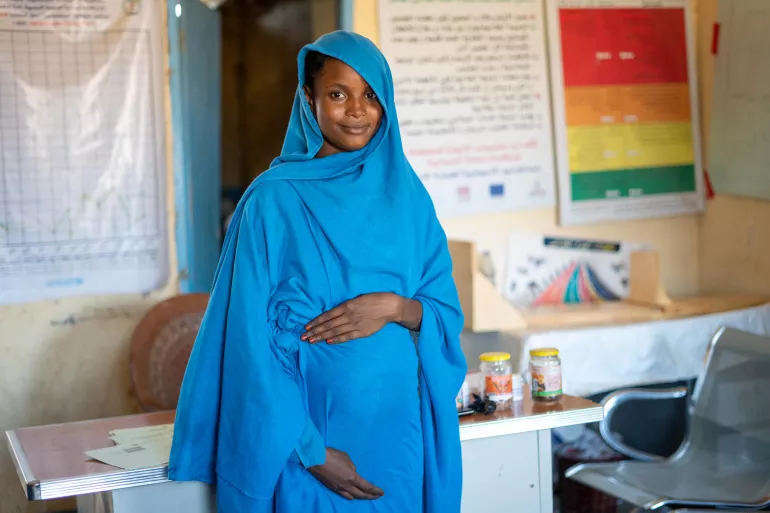
Every day in Sudan, women continue to become pregnant, attend antenatal appointments where services remain available, go into labour and give birth while the country’s health system operates under extraordinary pressure.
In 2026, an estimated 1.1 million pregnant women in Sudan need humanitarian assistance, according to the United Nations Population Fund (UNFPA). Around 7.3 million women of reproductive age are among the population requiring support.
For many women, the danger is not pregnancy alone.
It is pregnancy without reliable access to a midwife.
Labour without a functioning referral system.
Severe bleeding without blood for transfusion.
A complication requiring surgery when the nearest hospital is hours away.
Or a newborn requiring urgent care in a health system where facilities, staff and medical supplies have been severely disrupted.
Understanding Sudan’s healthcare crisis therefore requires looking at one essential fact:
Pregnancy and childbirth cannot be postponed until the conflict ends.
Why Pregnancy Requires Healthcare Before Labour Begins
A safe birth starts long before contractions begin.
Antenatal care allows health workers to monitor the health of the mother and baby throughout pregnancy.
Appointments may include checks of blood pressure, assessment of fetal growth, identification of anaemia or infection, vaccination, nutrition counselling and preparation for delivery.
They can also help identify pregnancies that may require additional medical attention.
A woman with dangerously high blood pressure, for example, may appear healthy while developing a condition that could become life-threatening.
Antenatal care creates opportunities to detect risks before they become emergencies.
But access becomes much harder during conflict.
Families may have been displaced away from their usual clinic.
Transport may be expensive or unsafe.
Health facilities may be closed.
Medical records may have been lost during displacement.
And women who move repeatedly may receive care from different providers or go for long periods without any care at all.
Despite these challenges, UNFPA-supported partners recorded 14,335 antenatal-care visits during July 2026 across their humanitarian response in Sudan.
Each visit represents more than a routine appointment.
In a damaged healthcare system, it can be one of the few opportunities to identify a problem before childbirth.
What Happens When Labour Becomes an Emergency?
Most people think of childbirth as a natural process.
It is.
But natural does not mean risk-free.
Some women develop complications that require immediate medical intervention.
These can include severe bleeding, infection, prolonged or obstructed labour, dangerously high blood pressure and other conditions that cannot always be predicted in advance.
This is why a functioning maternity system needs more than a room where a woman can give birth.
Basic emergency obstetric care can require medicines to control bleeding or seizures, antibiotics, management of retained placenta and assisted delivery.
Comprehensive emergency obstetric care requires additional capabilities, including caesarean section and safe blood transfusion.
Those services depend on an entire chain working correctly.
A trained health worker must recognize the complication.
The woman needs to reach an appropriate facility.
The facility needs qualified staff.
Medicines must be available.
Equipment must function.
Blood may need to be available.
Electricity, clean water and sterilization systems may also be required.
If one link fails, a manageable complication can become much more dangerous.
Sudan’s Wider Health Crisis Makes Childbirth More Difficult
Maternal health services operate inside Sudan’s wider healthcare system.
That system has been severely affected by more than three years of conflict.
WHO reported in April 2026 that 37 percent of health facilities across Sudan’s 18 states were non-functional, while approximately 21 million people lacked adequate access to health services.
The situation can be worse in areas experiencing active conflict.
Hospitals and clinics may be destroyed, damaged or unable to operate because staff have fled or supplies cannot reach them.
WHO has also documented repeated attacks on healthcare facilities, workers, ambulances and patients during the conflict.
For maternity care, the consequence is simple.
When general healthcare capacity collapses, pregnancy becomes more dangerous too.
A closed hospital does not only affect trauma patients.
It may remove an operating theatre needed for an emergency caesarean section.
It may remove the nearest blood bank.
It may eliminate the referral hospital serving dozens of smaller clinics.
Distance Can Turn a Complication Into a Crisis
A maternity clinic does not need to provide every possible service.
But it needs somewhere to refer patients when more advanced treatment is necessary.
That referral system becomes difficult during conflict.
Roads may be damaged.
Fuel may be expensive.
Ambulances may be unavailable.
Checkpoints or insecurity may make travel dangerous.
Flooding can cut off roads during the rainy season.
A journey that once took 30 minutes may take several hours or become impossible.
The experience of displaced communities in Blue Nile State illustrates the problem.
After intense fighting displaced tens of thousands of people during the first five months of 2026, UNFPA-supported humanitarian midwives described assisting women in communities where some had been forced to give birth while travelling because healthcare was difficult to reach.
This is one reason maternity care cannot be measured only by whether a hospital exists.
The real question is:
Can a pregnant woman reach appropriate care in time?
Midwives Can Be the Difference Between Isolation and Care
Midwives play an especially important role when healthcare systems are under pressure.
They can provide antenatal care, support normal deliveries, identify warning signs, provide postnatal care and refer women when complications require higher-level treatment.
In communities far from hospitals, they may be the health professional a pregnant woman can reach most easily.
During displacement, that role becomes even more important.
UNFPA has deployed and supported humanitarian midwives in areas where communities have been cut off from normal healthcare.
Its broader maternal-health work in Sudan has included mobile teams, roving midwives, community-midwife support and medical supplies for reproductive-health services.
But a midwife cannot replace an entire health system.
A trained midwife can recognize severe bleeding.
She still needs somewhere to refer a patient who requires surgery or blood.
Strengthening maternity care therefore means supporting both community-level providers and functioning referral hospitals.
Skilled Attendance During Birth Matters
In July 2026 alone, UNFPA-supported partners provided skilled attendance for 6,762 deliveries across 52 localities in 17 states.
During the same month, they recorded more than 14,000 antenatal visits and more than 4,000 postnatal visits.
These numbers demonstrate the scale of ongoing demand.
Women continue needing care regardless of conflict conditions.
Skilled attendance does not mean every delivery requires a doctor or advanced hospital.
It means having a properly trained professional who can support childbirth safely, identify complications and know when additional care is required.
That is particularly important because deterioration during childbirth can happen quickly.
The difference between recognizing a complication immediately and recognizing it several hours later can be critical.
Caesarean Sections Depend on Much More Than a Surgeon
When a woman requires an emergency caesarean section, the healthcare system must respond quickly.
But surgery depends on more than the availability of one surgeon.
The facility may need:
- anaesthesia;
- sterile surgical equipment;
- antibiotics;
- trained nurses;
- electricity;
- water;
- laboratory services;
- blood transfusion capacity; and
- safe postoperative monitoring.
Conflict can interrupt any of these.
A hospital may remain physically open while lacking the equipment or staff required to perform emergency surgery consistently.
This distinction is important when discussing healthcare availability.
A functioning building does not necessarily mean that every medical service is functioning.
For maternity care, what matters is whether women can access the specific level of care required when complications develop.
Pregnancy During Displacement Creates Additional Barriers
Sudan’s displacement crisis changes almost every part of pregnancy.
A displaced woman may be living far from the clinic where she began antenatal care.
She may no longer have her health records.
She may not know which nearby facilities are functioning.
She may have limited privacy in a crowded shelter.
Transport costs may be unaffordable.
Food insecurity can affect nutrition.
Unsafe water and poor sanitation can increase exposure to illness.
And repeated displacement can make continuity of care extremely difficult.
UNFPA reports that women and girls in some of Sudan’s hardest-hit regions may be hours away from life-saving reproductive healthcare.
For someone requiring routine care, those hours are difficult.
During severe bleeding or obstructed labour, they can become dangerous.
Food Security Is Also a Maternal-Health Issue
Pregnancy increases nutritional needs.
But millions of Sudanese families are struggling to access adequate food.
WHO identifies acute malnutrition and its complications among both children and pregnant women as a major health risk in Sudan’s 2026 emergency.
Poor nutrition during pregnancy can interact with other health problems, including anaemia and infection.
But it is important not to oversimplify the relationship.
Providing food does not replace antenatal care.
And medical care does not replace adequate nutrition.
Maternal health depends on multiple systems working together.
A pregnant woman may simultaneously need food assistance, clean water, medical monitoring and safe transport to a facility.
That is why humanitarian sectors cannot operate entirely in isolation.
Clean Water Matters Inside Maternity Facilities Too
Water is usually discussed as a household need.
It is also essential healthcare infrastructure.
Maternity services require water for hygiene, cleaning, infection prevention and safe patient care.
Health workers need to wash their hands.
Equipment and spaces need to be cleaned.
Patients need safe water.
Sanitation needs to function.
When water infrastructure is damaged, the ability of a clinic to provide safe maternity care can also be affected.
The same is true of electricity.
A power failure can affect lighting, refrigeration, laboratory equipment and surgical services.
This is why restoring health services after conflict sometimes means repairing much more than medical equipment.
Water systems, electricity and buildings all form part of healthcare.
Childbirth Is Not the End of Maternal Care
Attention often focuses on labour.
But the hours and days after birth also matter.
Postnatal care allows health workers to assess the mother for complications, support breastfeeding, examine the newborn and identify warning signs requiring additional treatment.
WHO’s Sudan health-service framework includes examination of both mother and newborn during the postnatal period, together with breastfeeding and other counselling.
UNFPA-supported partners recorded 4,018 postnatal consultations in July 2026.
For displaced women, however, returning for follow-up may be difficult.
A woman may leave a facility and return to a temporary settlement far away.
Transportation may cost money the family does not have.
Or the same facility may no longer be accessible several days later.
Continuity matters after birth just as it does during pregnancy.
Newborns Face the Same Fragile Health System
A safe delivery does not guarantee that a newborn will not need medical care.
Some babies are born premature.
Some have low birth weight.
Others may experience breathing difficulties, infection or complications during delivery.
WHO specifically identifies preventable maternal and neonatal deaths caused by gaps in skilled birth attendance and emergency obstetric care among Sudan’s priority health risks in 2026.
Newborn care therefore has to be considered alongside maternal care.
The mother and baby are not separate humanitarian cases.
They are part of the same continuum of care.
A maternity programme that helps a woman deliver safely but cannot identify or refer a sick newborn is incomplete.
Flooding Can Disrupt Maternity Care Overnight
Healthcare access is also affected by Sudan’s climate and seasonal hazards.
In late July 2026, heavy rain in White Nile State damaged a UNFPA-supported maternity clinic as flooding affected displaced and host communities in Khor Ajwal and Rabak localities.
This demonstrates how overlapping emergencies compound risk.
Conflict weakens infrastructure.
Displacement concentrates people in vulnerable locations.
Then flooding damages shelters, roads or clinics.
Pregnancy continues through all three.
Humanitarian maternity services therefore need contingency planning for changes in access, population movement and infrastructure.
Funding Shortages Can Close Services Even When Demand Is Growing
A healthcare facility can have patients, trained staff and enormous need and still reduce services because funding disappears.
In June, the Sudan Health Cluster warned that funding disruption could affect 335 health facilities and services across 13 states.
The potentially affected workforce included 1,848 doctors, nurses, midwives and other health professionals.
Health Cluster partners warned that reductions could affect maternal and child health services, primary healthcare, referrals and access to medicines.
UNFPA faces similar financial pressure.
Its 2026 Sudan appeal requires $129.2 million for reproductive-health and protection needs.
As of July, only 34 percent had been funded, leaving an approximately $86 million shortfall.
Funding gaps are not abstract accounting problems.
They can translate into fewer midwives, fewer mobile teams, fewer supplies or fewer functioning clinics.
What Does a Strong Humanitarian Maternal-Health Response Need?
No single intervention can make childbirth safe during a health-system crisis.
A stronger response requires several layers working together:
- antenatal care;
- trained midwives and skilled birth attendants;
- functioning maternity facilities;
- emergency obstetric and newborn care;
- caesarean-section capacity;
- safe blood transfusion;
- medicines and medical supplies;
- referral systems and transport;
- postnatal services;
- nutrition support;
- clean water and sanitation;
- protection services; and
- care for newborn complications.
Mobile clinics can improve access.
Community midwives can bring care closer to displaced populations.
Cash assistance can sometimes help women reach facilities.
Medical supplies can keep maternity wards functioning.
But these interventions work best when they connect into a broader healthcare system rather than operating as isolated projects.
Where Amel Foundation Fits
Amel Foundation identifies healthcare as one of its core programme areas in Sudan, alongside food security, water, child support and emergency assistance.
Its documented humanitarian work has included free medical days and other community-health support intended to bring basic services closer to vulnerable populations.
That contribution should be described accurately.
Amel’s general healthcare programmes are not the same as specialist maternity hospitals or comprehensive emergency obstetric services unless a specific project has been documented as providing those services.
But community health support still matters within Sudan’s wider healthcare response.
Pregnant women live within the same communities affected by displacement, food insecurity, limited water and reduced access to medical care.
Strengthening basic healthcare helps support the environment in which maternal and newborn health must also function.
Pregnancy Cannot Wait for the Crisis to End
Sudan’s healthcare emergency is often described through damaged hospitals, outbreaks and millions of people lacking services.
Maternal health reveals what those statistics mean in everyday life.
A woman still reaches the final month of pregnancy.
Labour still begins.
Complications still occur.
A newborn still needs help breathing.
Severe bleeding still requires immediate treatment.
None of these events can be rescheduled until roads reopen or hospitals recover.
That is why maternity care must remain part of any serious humanitarian health response.
Sudan needs functioning hospitals.
It needs community clinics.
It needs midwives.
It needs referral systems.
It needs blood, medicines, clean water and reliable power.
And it needs enough sustained funding to keep those systems operating.
For more than one million pregnant women living through Sudan’s humanitarian crisis, the question is not simply whether healthcare exists somewhere in the country.
It is whether the right care can be reached at the moment it is needed.
Because during pregnancy and childbirth, delays can carry consequences that cannot always be reversed.
Supporting Healthcare in Sudan
Amel Foundation supports healthcare and other humanitarian programmes serving vulnerable communities affected by conflict and displacement in Sudan.
Learn more about Amel Foundation’s humanitarian work at AmelFoundation.org.

Comments are closed