
Updated: September 2026
A family fleeing conflict does not leave fear behind when it reaches a safer place.
A child may no longer hear fighting but still struggle to sleep.
A parent may find shelter but continue worrying about food, relatives left behind and what will happen tomorrow.
Someone may return home only to find the neighbourhood damaged, friends gone and the life they knew no longer there.
Sudan’s humanitarian crisis has lasted for more than three years, creating not only physical needs for food, healthcare, water and shelter, but also profound pressure on people’s emotional and social wellbeing.
As of August 2026, approximately 8.58 million people remained internally displaced across Sudan, according to the International Organization for Migration. Around 55 percent of them were children under 18.
But understanding the mental-health consequences of this crisis requires care.
Experiencing fear, sadness, grief, anger or difficulty sleeping after violence or displacement does not automatically mean someone has a mental disorder.
WHO explains that almost everyone affected by a humanitarian emergency experiences some form of psychological distress. For many people, these reactions improve over time, especially when safety, stability and social support return.
Others, however, may need more focused or specialized support.
That is why mental health in Sudan cannot be separated from the wider humanitarian response.
Conflict Affects More Than Physical Safety
Humanitarian emergencies change almost every part of daily life.
People may lose:
- homes;
- family members;
- livelihoods;
- schools;
- familiar communities;
- healthcare;
- possessions;
- routines; and
- expectations about the future.
Each loss adds another source of pressure.
WHO notes that humanitarian emergencies commonly expose people to violence, bereavement, poverty, overcrowding, discrimination and uncertainty over basic resources all factors that can increase psychological distress and the risk of mental-health conditions.
In Sudan, many people have experienced several of these pressures simultaneously.
A family may be grieving someone who died while also searching for food.
A parent may be worried about a child’s safety while trying to find work.
A displaced person may be living in an overcrowded shelter while receiving news that fighting has reached another relative’s town.
Mental wellbeing is therefore influenced not only by what happened during the violence.
It is also affected by what happens every day afterwards.
Repeated Displacement Can Prevent People From Regaining Stability
Leaving home once can be deeply disruptive.
Some Sudanese families have been forced to leave more than once.
A family may first flee from Khartoum to Aj Jazirah, then move again when insecurity spreads.
Others have moved between states or crossed borders before eventually returning.
UNICEF has documented cases of Sudanese children whose families have experienced multiple rounds of displacement as the conflict moved into areas they initially considered safe.
Repeated displacement makes it difficult to rebuild routine.
Each move can mean another lost home.
Another interrupted school year.
Another separation from neighbours.
Another search for healthcare.
Another period of uncertainty about where the family will sleep next.
Psychosocial recovery becomes harder when the environment itself never becomes stable.
Safety is therefore part of mental-health support.
People cannot easily regain a sense of security while constantly preparing to flee again.
Children Experience Displacement Differently
Children do not always express distress in the same way adults do.
A young child may become unusually quiet or cling to caregivers.
Another may become irritable or have difficulty sleeping.
Older children may worry about school, friends, family members or whether they will ever return home.
None of these reactions should automatically be treated as a diagnosis.
Children are responding to circumstances that would be overwhelming for many adults.
Sudan’s crisis has disrupted several of the things that normally create stability during childhood:
home, school, play, friendships, family routines and predictable caregiving.
This is why child protection programmes increasingly connect psychosocial support with education and safe spaces.
During the first half of 2026, UNICEF and partners reported providing 940,700 children and family members with mental health and psychosocial support in Sudan.
In July alone, UNICEF-supported child-protection programmes reached approximately 167,300 children, adolescents and caregivers with mental-health and psychosocial support.
The scale of those programmes reflects how significant the need has become.
Safe Spaces Can Restore Parts of Childhood
Mental-health support for children does not always begin in a therapist’s office.
Sometimes it begins with a safe place to play.
UNICEF-supported child-friendly spaces in Sudan bring children together in supervised environments where they can participate in recreation, learning and psychosocial activities.
At Alkashafa camp in White Nile State, for example, trained facilitators support children through play and structured activities while also providing access to psychosocial support.
In Gedaref, UNICEF’s Makanna spaces similarly combine learning, recreation and psychosocial support for children affected by conflict and displacement.
These spaces matter for a simple reason:
routine can itself be protective.
Knowing where they will go each morning.
Seeing familiar adults.
Playing with other children.
Drawing.
Learning.
Having a predictable activity.
None of these removes what a child has experienced.
But they can help rebuild a sense of normal life.
Parents and Caregivers Are Carrying Their Own Psychological Burden
Children’s wellbeing is closely connected to the adults caring for them.
Sudanese parents and caregivers may be trying to protect children while experiencing their own grief, fear and exhaustion.
They may have lost employment.
They may not know how they will pay for food tomorrow.
They may be separated from spouses or relatives.
They may be caring for elderly family members.
They may also be trying to appear calm so that children feel safe.
This creates an enormous emotional burden.
Supporting children’s mental health therefore often requires supporting caregivers too.
That is one reason UNICEF’s psychosocial programmes count children, adolescents and caregivers, rather than treating children in isolation.
A caregiver who receives practical support, information and opportunities to regain stability may be better able to provide a reassuring environment for children.
This does not mean parents are responsible for preventing all distress.
It means families function as systems.
Helping one member can strengthen the support available to others.
Grief Is Part of Sudan’s Mental-Health Crisis
Many families are also living with bereavement.
People have lost parents, children, siblings, friends and neighbours.
Others do not know whether missing relatives are alive.
Grief during conflict can become especially difficult because normal social and cultural practices surrounding death may be disrupted.
Families may be displaced far from relatives.
Travel may be impossible.
Communities that normally support mourning may have scattered.
People may also be grieving several things at once.
Not only a person.
A home.
A neighbourhood.
A livelihood.
A school.
A future they expected to have.
Humanitarian psychosocial support therefore needs to make room for grief rather than treating every painful emotional response as an illness.
WHO distinguishes between normal psychological distress following emergencies and mental-health conditions requiring more specialized care.
Both deserve attention.
But they do not require identical responses.
Mental Health Is Connected to Food, Water and Shelter
One of the most important principles in humanitarian mental health is that emotional wellbeing cannot be separated from basic living conditions.
Someone worried about whether their children will eat tomorrow may not primarily need counselling.
They may need food.
A family sleeping in an unsafe shelter may need security.
A person spending hours searching for clean water may need a functioning water source.
This is reflected in the international framework used for mental health and psychosocial support in emergencies.
The IASC model describes several layers of support, beginning with basic services and security, followed by community and family support, focused non-specialized support and specialized mental-health services.
The point is important.
Mental-health response is not only psychiatric treatment.
Providing food safely and respectfully can support wellbeing.
Restoring family connections can support wellbeing.
Helping children return to education can support wellbeing.
Providing a safe shelter can support wellbeing.
The humanitarian environment itself affects mental health.
What Does “MHPSS” Actually Mean?
Humanitarian organizations frequently use the term MHPSS.
It stands for:
Mental Health and Psychosocial Support.
The term intentionally covers a wide range of services.
At the broadest level, support includes ensuring people’s basic needs are met in ways that protect dignity and safety.
The next level focuses on strengthening families and communities.
More focused interventions may then be provided by trained workers to individuals or groups who need additional help.
Finally, specialized psychological or psychiatric services are necessary for people experiencing severe or persistent mental-health conditions.
This layered approach avoids two common mistakes.
The first is assuming that everyone affected by war needs therapy.
The second is assuming that nobody requires specialist care because distress is a normal response to crisis.
Both can be wrong.
Different people need different levels of support.
Community Connections Can Be Protective
Conflict often damages the social networks people rely on.
Neighbours separate.
Extended families scatter.
Community organizations stop functioning.
Schools and places of gathering close.
Rebuilding those connections can become part of psychosocial recovery.
The IASC framework specifically recognizes community and family support as an important layer of humanitarian MHPSS.
Examples can include family reunification, supportive parenting programmes, education, youth activities, women’s groups, livelihoods and opportunities to rebuild social networks.
This is especially relevant in Sudan, where local volunteers and community networks have become important parts of the wider humanitarian response.
People do not recover only as individuals.
Communities can also help create the relationships and routines that allow people to regain stability.
Women and Girls May Face Additional Pressures
Conflict and displacement can create specific psychological and protection pressures for women and girls.
These can include:
- fear of gender-based violence;
- unsafe shelter arrangements;
- harassment;
- loss of privacy;
- economic dependency;
- separation from support networks; and
- caring responsibilities during displacement.
UNFPA reported that in January and February 2026 it reached more than 51,000 people with services related to gender-based violence, including mental-health and psychosocial support, individual and group counselling and case management.
Nearly 80 percent of those services were provided to internally displaced people.
UNFPA was operating 88 women and girls’ safe spaces, including temporary sites inside displacement camps.
These spaces demonstrate another important principle:
mental-health support sometimes works best when it is integrated with protection and practical services rather than provided separately.
Survivors of Violence May Need Focused Support
Some experiences create needs beyond general community support.
Survivors of gender-based violence, torture or severe violence may need confidential case management and focused psychosocial care.
People experiencing persistent symptoms that seriously interfere with daily functioning may require professional assessment.
Those with pre-existing mental-health conditions may also lose access to medication or treatment during displacement.
WHO described Sudan’s mental-health system as already fragile before being further disrupted by conflict, with severe shortages of trained professionals and resources.
This creates a double challenge.
New needs are increasing while existing services are becoming harder to provide.
Humanitarian MHPSS must therefore include referral pathways so that people requiring specialized support are not left only with general community activities.
Returning Home Does Not Automatically End Psychological Distress
Sudan is now experiencing substantial return movements alongside continued displacement.
By August 2026, IOM recorded more than 5.1 million returned individuals.
Going home can bring relief.
But return can also create new emotional pressures.
A family may discover that its house has been destroyed.
A child may find that friends have moved away.
A shopkeeper may return to a business that no longer exists.
Neighbourhoods may still contain reminders of violence.
Services may remain damaged.
The physical journey home therefore does not automatically complete psychological recovery.
People may need time to rebuild relationships, livelihoods, routines and a sense of safety.
Mental-health and psychosocial support should therefore continue into recovery rather than ending as soon as someone stops being classified as displaced.
Education Can Be Part of Psychosocial Recovery
School is usually discussed as an education issue.
During humanitarian emergencies, it can also provide structure and social connection.
A classroom offers children:
- a routine;
- contact with peers;
- trusted adults;
- opportunities to play and learn; and
- a sense that life contains something beyond the emergency.
That does not mean school can treat serious mental-health conditions.
But restoring safe education can strengthen the environment in which children recover.
This is why many emergency education programmes combine learning with psychosocial support and child-protection referrals.
The same principle applies to youth activities, community groups and safe spaces.
Mental-health response is stronger when it connects with the places where people already live their lives.
Funding Determines Whether Support Can Continue
Psychosocial services require trained workers, safe spaces, supervision, referral systems and coordination.
Those systems require funding.
UNICEF’s Sudan humanitarian appeal remained 63 percent unfunded at the end of July 2026, despite substantial needs across child protection, health, education, nutrition and other sectors.
UNFPA has also reported large funding gaps affecting protection and psychosocial services for women and girls.
When funding falls short, the consequence can be fewer safe spaces, fewer trained workers, reduced case-management capacity and weaker referral networks.
Mental-health support is sometimes treated as something to add only after food and medicine have been funded.
Humanitarian guidance suggests a different approach.
Psychosocial wellbeing should be considered across the entire response, from how food distributions are managed to how schools, shelters, protection and healthcare services are designed.
Where Amel Foundation Fits
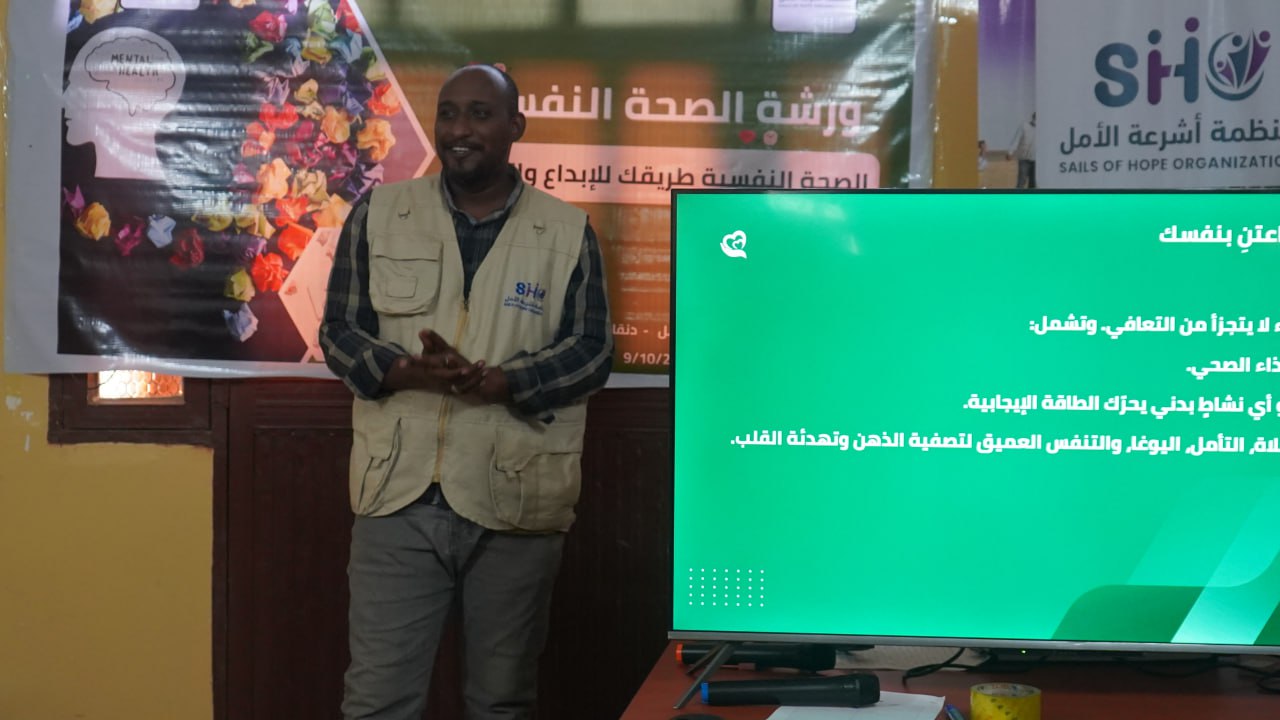
Amel Foundation’s humanitarian programmes in Sudan focus on interconnected needs including food security, healthcare, water, child welfare, education-related support and emergency assistance.
Those programmes should not be presented as specialist mental-health treatment unless a specific project has been documented to provide that service.
But they operate within the environment that affects psychosocial wellbeing.
A child with reliable food and access to education has different daily pressures from a child who does not know when the next meal will come.
A family with safe water faces one fewer source of constant worry.
Healthcare access can help people manage physical conditions that add to distress.
Child-welfare programmes can strengthen the support around vulnerable children.
Amel’s internal programme documentation also includes psychosocial care within its broader child-welfare approach.
The appropriate role is therefore not to claim that humanitarian assistance “heals trauma.”
It is to recognize that meeting basic needs, protecting dignity and strengthening community support can create better conditions for recovery.
Mental-Health Support Is Part of Humanitarian Recovery
Sudan’s mental-health challenge cannot be measured by one number.
Not everyone affected by the conflict will develop a mental-health condition.
Not everyone experiencing sadness, fear or sleeplessness requires clinical treatment.
But prolonged conflict, bereavement, repeated displacement and uncertainty place enormous psychological pressure on individuals, families and communities.
The response needs to reflect that complexity.
Some people need safe spaces.
Some need family and community support.
Some need practical assistance that restores stability.
Some need focused counselling.
And some need specialized psychiatric or psychological care.
All of those forms of support matter.
Because surviving a humanitarian crisis is not only about remaining physically alive.
It is also about protecting people’s ability to care for their families, rebuild relationships, return to school, regain livelihoods and imagine a future beyond the emergency.
As Sudan moves through another year of conflict, displacement and return, mental-health and psychosocial support should not be treated as an optional addition to humanitarian response.
It is part of helping people rebuild their lives.
Supporting Communities in Sudan
Amel Foundation supports humanitarian programmes addressing food, water, healthcare, children and other essential needs affecting vulnerable communities across Sudan.
Learn more about Amel Foundation’s humanitarian work at AmelFoundation.org.

Comments are closed